
UAE eInvoicing is not simply a project to replace PDF invoices with XML files. It changes how invoice data is created, exchanged, validated and reported, and it introduces new dependencies across tax, finance, master data, ERP, integration and operations.
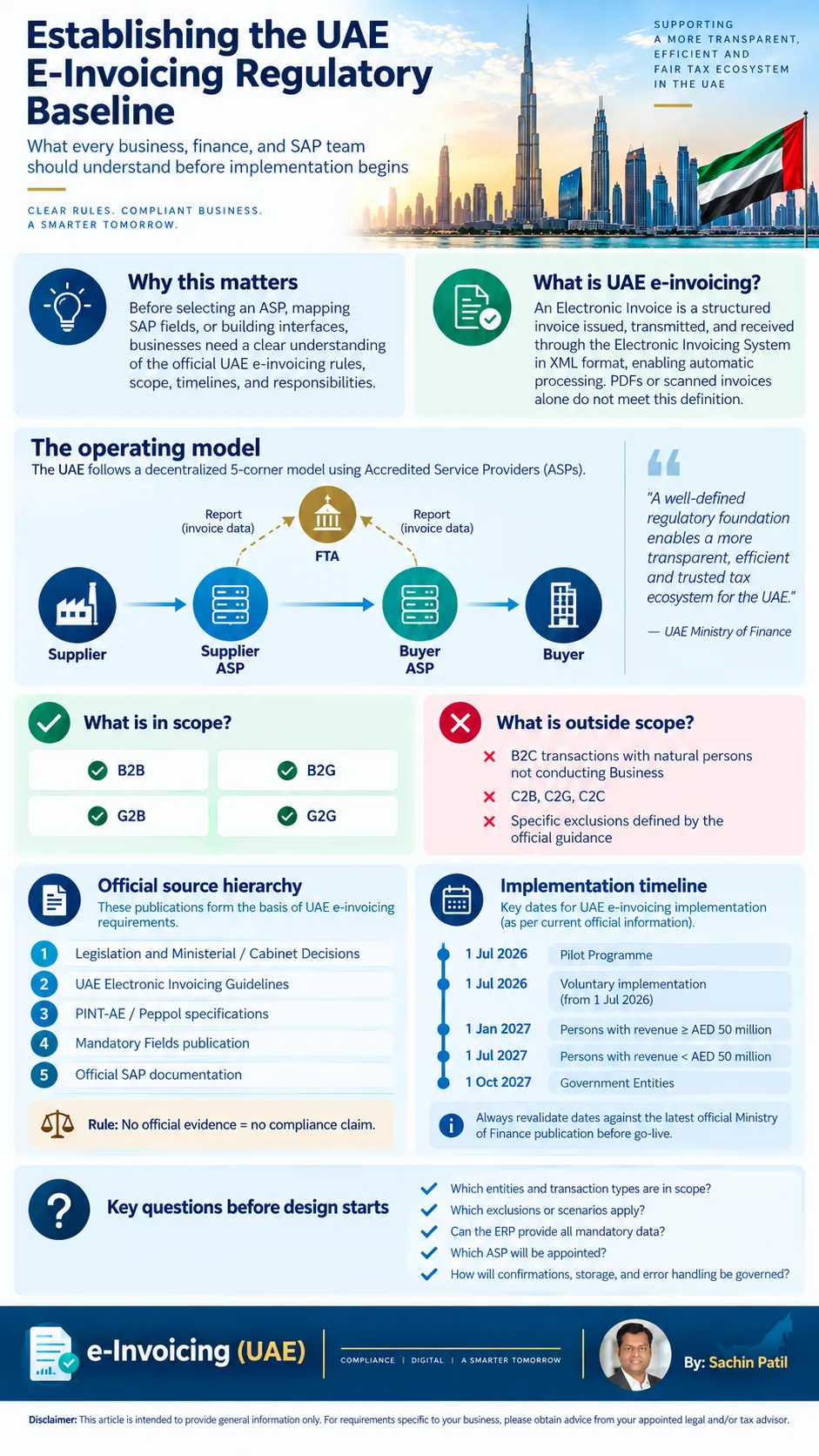
Before selecting an Accredited Service Provider (ASP), configuring SAP, mapping invoice fields or building interfaces, the implementation team needs one shared view of the official UAE requirements. That regulatory baseline is the foundation for every design decision that follows.
Quick answer
UAE eInvoicing requires structured invoice data to be exchanged through the UAE Electronic Invoicing System. The UAE uses a Peppol-based Decentralized Continuous Transaction Control and Exchange (DCTCE) 5-corner model in which the supplier and buyer exchange Electronic Invoices through their ASPs, while Tax Data is reported to the Federal Tax Authority (FTA).
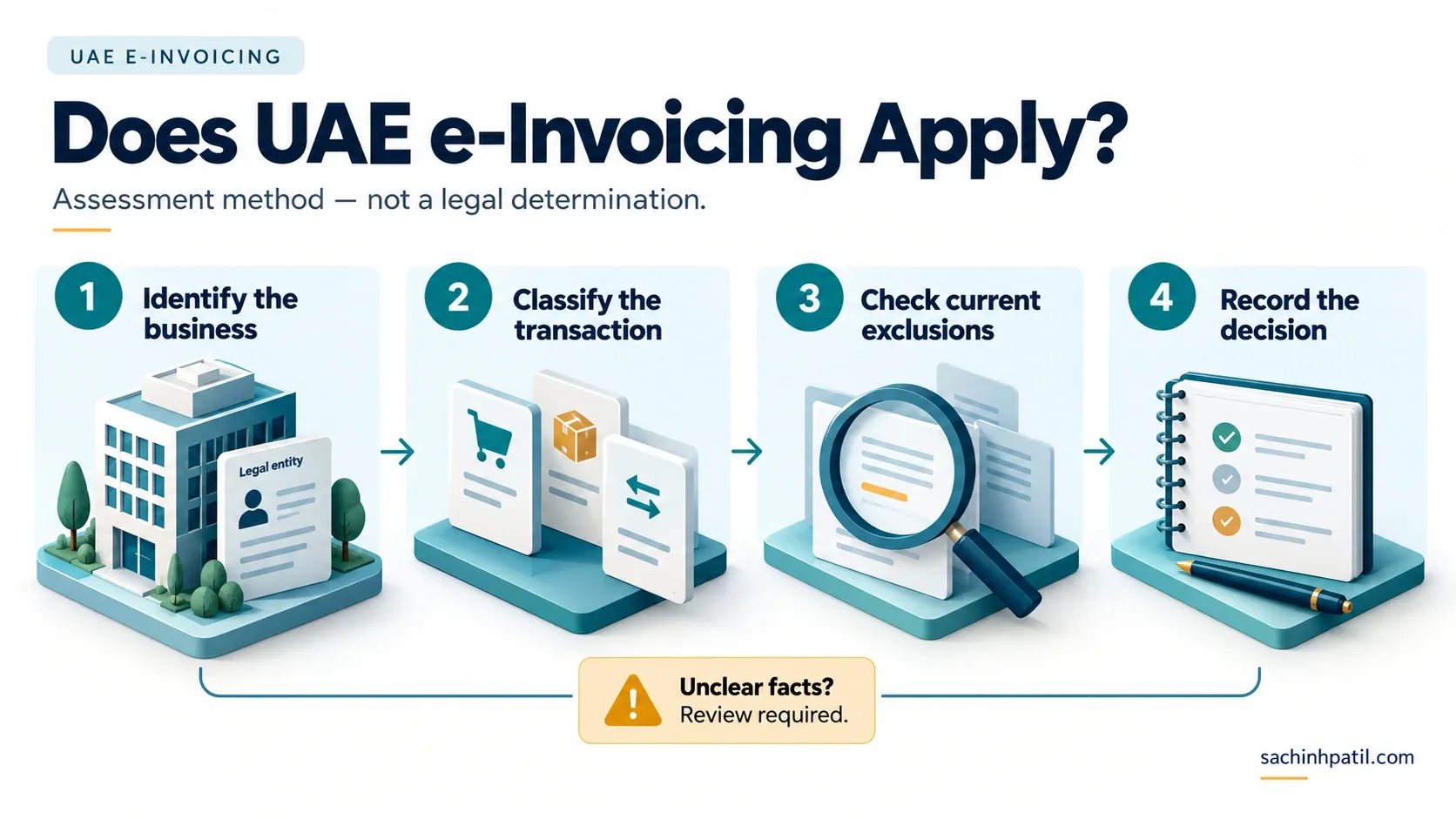
The first implementation task is therefore not XML development. It is to establish scope, legal-entity applicability, transaction classification, official data requirements, rollout dates, ASP responsibilities and operational controls from authoritative sources.
What qualifies as an Electronic Invoice in the UAE?
The official UAE definition is narrower than the everyday meaning of an “electronic invoice”.
An Electronic Invoice is an invoice issued, transmitted and received through the Electronic Invoicing System in a structured electronic format that enables automatic and electronic processing. The Ministry of Finance also states that unstructured formats such as PDFs, Word documents, images, scanned copies and emails are not eInvoices by themselves.
That distinction changes the technical target.
The compliance objective is therefore not “send invoices electronically”. It is to create, exchange and report structured invoice data through the prescribed model.
Official evidence: UAE Ministry of Finance eInvoicing portal
Why the regulatory baseline must come before ERP design
A project can build a technically successful interface and still get the compliance design wrong.
For example, the integration may transmit a valid XML document, but the underlying transaction may have been classified incorrectly, the wrong entity may have been onboarded, a required identifier may be missing, or a transaction may have been included or excluded using the wrong rule.
The Ministry’s readiness guidance starts with understanding the requirements and identifying changes needed in accounting, ERP and invoicing systems. Only then does it move into ASP selection, testing and go-live.
A practical sequence is:
- Confirm the legal entities and Business Transactions in scope.
- Identify exclusions and special scenarios.
- Determine the Electronic Invoice category.
- Assess the source data required by PINT-AE and the Mandatory Fields publication.
- Select and onboard the ASP.
- Design the ERP/integration solution.
- Test invoice exchange, Tax Data reporting and confirmation messages.
- Establish operational governance before go-live.
For an SAP programme, this means the regulatory requirement should be traced into SAP, rather than starting with an assumed SAP architecture and trying to fit the regulation around it.
Use the right hierarchy of official sources
Not every document has the same purpose. A useful implementation hierarchy is:
The June 2026 UAE Electronic Invoicing Guidelines state that they should be read together with Ministerial Decision No. 243 of 2025, Ministerial Decision No. 244 of 2025, Ministerial Decision No. 64 of 2025 and Cabinet Decision No. 106 of 2025.
A simple project rule helps:
No official evidence = no compliance claim.
If the regulation defines the outcome but does not prescribe how your ERP must implement it, the ERP design should be labelled as an implementation decision, not as a UAE regulatory requirement.
How the UAE 5-corner model works
The UAE uses a Decentralized Continuous Transaction Control and Exchange (DCTCE) model. The five corners are:
| Corner | Participant | High-level role |
|---|---|---|
| Corner 1 | Supplier | Creates and submits Electronic Invoice data |
| Corner 2 | Supplier’s ASP | Validates, transforms where required, exchanges and reports |
| Corner 3 | Buyer’s ASP | Validates, delivers to buyer and reports where applicable |
| Corner 4 | Buyer | Receives the Electronic Invoice |
| Corner 5 | Federal Tax Authority | Receives the required Tax Data and returns reporting status |
At a high level, the official process is:
- Corner 1 sends invoice data to Corner 2 in an agreed format.
- Corner 2 validates the data and converts it to the UAE standard XML if required.
- Corner 2 sends the Electronic Invoice to Corner 3.
- In parallel, Corner 2 reports the required Tax Data to Corner 5.
- Corner 3 validates the Electronic Invoice and returns status to Corner 2.
- Corner 3 delivers the invoice to Corner 4 in the agreed format.
- After successful validation, Corner 3 also reports Tax Data to Corner 5. If validation fails, the failure is reported instead and no normal Tax Data reporting is made by Corner 3 for that unsuccessful validation.
- Corner 5 returns the relevant reporting confirmation.
- Confirmation messages flow back through the ASPs to the supplier and buyer.
The current Ministry of Finance portal uses the terms Tax Data Document (TDD) for the reported tax dataset and Message Level Status (MLS) for status messages.
This is why the shorthand ERP → FTA is misleading. Invoice exchange occurs through the ASP/Peppol network, while the FTA participates as Corner 5 for tax reporting.
Official evidence: UAE eInvoicing Programme Introduction and UAE Ministry of Finance eInvoicing portal
What the ASP is responsible for — and what it does not remove
An Accredited Service Provider (ASP) is a service provider accredited to provide Electronic Invoicing Services in the UAE.
The official guidelines assign ASP-related responsibilities that include:
- secure transmission;
- validating Electronic Invoice data;
- transforming invoice data into the UAE standard XML where necessary;
- looking up Peppol participant identifiers;
- generating a UUID for each Electronic Invoice;
- exchanging Electronic Invoices;
- reporting required Tax Data to the FTA;
- returning confirmation messages;
- providing technical support;
- security monitoring and data protection.
The important boundary is accountability. A business may use its ASP to perform operational activities, but appointing an ASP does not remove the business’s own compliance responsibilities.
ASP selection should therefore consider more than API connectivity. The implementation team should evaluate data exchange, validation coverage, operational support, security, storage arrangements, confirmation handling and error-resolution governance.
PINT-AE and XML are the technical baseline
The UAE Electronic Invoicing Guidelines state that Electronic Invoices are issued, transmitted and received in XML format. The required content is defined through Peppol PINT-AE.
PINT-AE provides the UAE-specific electronic document requirements while retaining Peppol interoperability. The specification includes the semantic model, syntax binding, code lists, business rules and validation artefacts.
The UAE guidelines also state that Electronic Invoices do not feature a QR code or barcode.
For an ERP team, the practical design principle is:
Do not begin by inventing a company-specific XML and later try to make it compliant. Start with the required semantic data and work backward into the source systems.
Official evidence: OpenPeppol UAE electronic document specifications
TIN, TRN and the Peppol Participant Identifier
Legal identity and network identity are connected.
The UAE guidelines define the Tax Identification Number (TIN) as a unique 10-digit identifier. For Persons already registered with the FTA for a tax type, the TIN is the first 10 digits of the Tax Registration Number (TRN).
The Participant Identifier, also referred to as an End Point ID, is used to identify the Person or Government Entity on the Peppol network. The UAE guidance defines it as:
0235 + 10-digit TINIn endpoint notation, this is commonly represented as:
0235:<TIN>This is not just an interface parameter. It is a master-data and onboarding dependency tied to the legal/tax identity of the participant.
Tax Group members need particular attention because the guidelines state that each member uses its own TIN rather than the Tax Group representative’s TIN.
Who is in scope?
The June 2026 guidelines state that Electronic Invoicing is mandatory for Persons conducting Business in the UAE in respect of Business Transactions, regardless of VAT registration status, unless specifically excluded.
At the high-level transaction matrix:
| Supplier | Buyer | Transaction | High-level scope |
|---|---|---|---|
| Business | Business | B2B | In scope |
| Business | Government | B2G | In scope |
| Government | Business | G2B | In scope |
| Government | Government | G2G | In scope |
| Business | Consumer | B2C | Outside scope |
| Government | Consumer | G2C | Outside scope |
| Consumer | Business | C2B | Outside scope |
| Consumer | Government | C2G | Outside scope |
| Consumer | Consumer | C2C | Outside scope |
The guidelines specifically explain that supplies to or from natural persons who are not conducting Business are not within the Electronic Invoicing scope.
That wording matters. A system should not use a simplistic “individual = out of scope” rule without understanding whether the Person is conducting Business.
Interactive scope explorer
Use the selector below as a high-level orientation tool only. It reflects the transaction matrix above; it does not assess exclusions, special scenarios or the detailed facts of a transaction.
Specific exclusions must be assessed separately
The guidelines identify specific exclusions. These include:
- qualifying sovereign activities of Government Entities;
- specified airline-related supplies;
- specified exempt financial services;
- other Business Transactions that may be determined by the Minister.
A crucial point is that VAT invoicing exceptions do not automatically become Electronic Invoicing exceptions. The Electronic Invoicing rules need to be checked on their own terms.
For implementation teams, scope should therefore be determined using at least three lenses:
VAT Group transactions: in scope, with a temporary grace period
The June 2026 Guidelines clarify that Business Transactions between members of the same VAT Group remain within the scope of Electronic Invoicing.
However, a temporary 24-month grace period commencing on 01 January 2027 applies to those intra-group Business Transactions. During that period, the Electronic Invoicing obligations do not need to be implemented for the intra-group transactions covered by the grace period.
The guidance is explicit that the grace period affects the timing of compliance, not the underlying scope.
This matters for large groups using centralized ERP platforms, intercompany billing, shared-service centres or automated allocation processes. Those transactions should remain in the long-term design even where the implementation sequencing differs.
Six Electronic Invoice categories
The guidelines define six Electronic Invoice categories.
Standard billing
- Electronic Tax Invoice
- Electronic Tax Credit Note
- Commercial Invoice
- Electronic Credit Note
Self-billing
- Self-billed Electronic Tax Invoice
- Self-billed Electronic Tax Credit Note
There is no separate Electronic Invoice category for a “provisional invoice”. Where provisional amounts are used, the relevant Electronic Invoice and subsequent adjustment rules need to be followed.
The document category should be established before mapping because the required content can differ by invoice type and scenario.
Eight transaction scenarios can change the required data
The official UAE guidance defines eight specific Electronic Invoice scenarios:
- Free Zone
- Deemed Supply
- Margin Scheme
- Summary Invoice
- Continuous Supply
- Disclosed Agent Billing
- Supply through e-Commerce
- Exports
More than one scenario can apply to a single transaction.
The Mandatory Fields publication reflects these scenarios through the Invoice transaction type code, which contains a sequence of flags identifying which scenarios apply.
For ERP design, this creates an important question:
Can the source system determine the correct scenario from the business transaction without manual interpretation downstream?
If the answer is no, that is a data or process gap that should be resolved before the final interface design.
Mandatory invoice data starts in the source system
The UAE Electronic Invoice Mandatory Fields publication lists 51 mandatory fields for an Electronic Tax Invoice.
They span several data groups:
| Data group | Examples |
|---|---|
| Invoice details | Invoice number, date, type code, currency, transaction type code, payment due date |
| Seller details | Name, electronic address, legal registration identifier, tax identifier, address |
| Buyer details | Name, electronic address, tax identifier, address |
| Document totals | Line net total, amount without tax, tax amount, amount with tax, amount due |
| Tax breakdown | Taxable amount, tax amount, category code, tax rate |
| Invoice line | Line ID, quantity, UoM, net amount, prices, tax category, VAT amount, item details |
Examples of line-level data include:
- Invoiced quantity
- Unit of measure code
- Invoice line net amount
- Item net price
- Item gross price
- Item price base quantity
- Invoiced item tax category code
- Invoiced item tax rate
- VAT line amount in AED
- Invoice line amount in AED
- Item name
- Item description
The exact requirement still depends on document type and scenario, and PINT-AE remains the detailed technical reference.
This is why data readiness should precede interface development.
Middleware can transform, validate and route data. It cannot reliably reconstruct missing legal, commercial or tax information that the business never captured.
Tax categories require business and tax mapping
The guidelines identify six tax categories for Electronic Invoicing:
- Standard Rate
- Exempt from VAT
- Goods and services outside the scope of VAT
- Reverse Charge
- Zero Rated
- Margin Scheme
For an ERP implementation, avoid reducing the design to:
ERP tax code → XML tax codeA safer model is:
Business transaction
        ↓
Tax treatment
        ↓
ERP tax determination
        ↓
UAE Electronic Invoice tax category
The mapping needs both technical and tax validation.
UAE eInvoicing implementation timeline
The implementation is phased. For the current phase, a countdown to the next deadline, dates filtered by revenue band and a calendar download, see the UAE e-invoicing timeline: where we are now.
The UAE Electronic Invoicing Guidelines V1.1 dated 01 June 2026 contain the rollout framework originally published under Ministerial Decision No. 244 of 2025. A later official amendment, Ministerial Resolution No. 66 of 2026, changed the ASP appointment deadline for Persons with Revenue equal to or exceeding AED 50 million.
| Entity | Last date to appoint an ASP | Mandatory implementation |
|---|---|---|
| Person with Revenue ≥ AED 50,000,000 | 30 October 2026 | 01 January 2027 |
| Person with Revenue < AED 50,000,000 | 31 March 2027 | 01 July 2027 |
| Government Entity | 31 March 2027 | 01 October 2027 |
The key lesson is not only the dates themselves. It is that regulatory dates can be amended.
The original first-phase ASP appointment deadline was 31 July 2026. Ministerial Resolution No. 66 of 2026 replaced it with 30 October 2026, while keeping the 01 January 2027 mandatory implementation date unchanged.
A programme should maintain a regulatory change log and revalidate dates at major gates such as design sign-off, testing and go-live.
Official evidence: Ministerial Resolution No. 66 of 2026
Onboarding and readiness
The guidelines describe a four-stage readiness path:
Before onboarding, a Person or Government Entity should understand the legal requirements and identify the changes needed in its accounting, ERP or invoicing applications.
After selecting and contracting with an ASP, onboarding is initiated through EmaraTax. The implementation then needs to cover both outbound and inbound Electronic Invoicing, status/confirmation handling, testing and operational error resolution.
The readiness checklist in the Guidelines asks organizations to confirm, among other things, that they have:
- identified the required invoice data points;
- ensured ERP/accounting systems can generate or extract them;
- completed necessary integration with the ASP;
- agreed how invoice data will be sent and received;
- agreed how confirmation messages will be handled;
- agreed data hosting and security requirements;
- completed end-to-end exchange and reporting tests;
- established governance for error resolution.
This is a useful baseline for project planning because it links tax compliance directly to data, integration and operations.
Storage and archival: do not oversimplify the “within the State” requirement
The June 2026 Guidelines provide detailed clarification on storage.
They specify statutory retention periods, including:
- 5 years following the relevant Tax Period for a Taxable Person;
- 5 years from the end of the calendar year in which the document was created for other Persons;
- 7 years from the end of the calendar year for specified real-estate records.
Additional retention periods can apply in defined circumstances such as disputes, tax audits or certain voluntary disclosures.
The Guidelines also clarify that compliant storage is not limited to one system layer or necessarily to servers physically located in the UAE. The key outcome is that records remain secure, complete, reproducible and available to the FTA when required.
An ASP may contractually store Electronic Invoices, Electronic Credit Notes and associated data on behalf of a Person, but the legal retention responsibility remains with that Person.
For enterprise architecture, this should be reflected explicitly in the archive design, data-governance model and ASP contract.
Status management: invoice exchange and tax reporting are not the same event
Operationally, one generic status such as Sent is unlikely to be enough.
The UAE model includes multiple events:
The current Ministry portal describes both TDD reporting and MLS confirmation within the 5-corner process.
When ERP monitoring is designed later, invoice exchange status and tax-reporting status should be treated as related but distinct operational outcomes.
Penalties make operational readiness part of compliance
Cabinet Decision No. 106 of 2025 defines specific violations and administrative penalties.
| Violation | Administrative penalty |
|---|---|
| Failure to implement the Electronic Invoicing System, including failure to appoint an ASP within the prescribed timeline | AED 5,000 for each month or part thereof |
| Failure to issue and transmit an Electronic Invoice within the prescribed timeline | AED 100 per Electronic Invoice, up to AED 5,000 per calendar month |
| Failure to issue and transmit an Electronic Credit Note within the prescribed timeline | AED 100 per Electronic Credit Note, up to AED 5,000 per calendar month |
| Issuer fails to notify the Authority of a System Failure within the prescribed timeline | AED 1,000 for each day of delay or part thereof |
| Recipient fails to notify the Authority of a System Failure within the prescribed timeline | AED 1,000 for each day of delay or part thereof |
| Issuer or Recipient fails to notify the appointed ASP of changes to data registered with the Authority within the prescribed timeline | AED 1,000 for each day of delay or part thereof |
The Decision also states that these Electronic Invoicing penalties do not apply to a Person participating voluntarily before mandatory implementation applies.
The practical implication is straightforward: monitoring, incident handling and master-data change governance are compliance controls, not merely IT support activities.
Official evidence: Cabinet Decision No. 106 of 2025
What should be agreed before solution design starts?
A regulatory-baseline workshop should be able to answer these questions.
Legal entity and applicability
- Which legal entities conduct Business Transactions in the UAE?
- Which rollout threshold applies to each entity?
- Is the entity part of a VAT Group?
- Are intra-group transactions relevant?
- Are non-UAE-established Persons involved?
Counterparty and transaction classification
- Is the counterparty a Business, Government Entity or consumer?
- Is the transaction B2B, B2G, G2B or G2G?
- Does a specific exclusion apply?
- Which of the eight Electronic Invoice scenarios applies?
Document classification
- Electronic Tax Invoice?
- Electronic Tax Credit Note?
- Commercial Invoice?
- Electronic Credit Note?
- Self-billed Electronic Tax Invoice or Electronic Tax Credit Note?
Master data
- Is the correct TIN available?
- Is the TRN available where required?
- Are legal registration details complete?
- Are addresses complete?
- Is the Peppol Participant Identifier available?
- Can buyers and suppliers be classified reliably?
Transaction data
- Can the ERP provide every applicable mandatory data point?
- Are tax categories mapped correctly?
- Are UoM codes available?
- Can invoice and VAT totals be reconciled?
- Can scenario-specific data be derived?
Integration and operations
- Which ASP will be appointed?
- How will outgoing data be transmitted?
- How will incoming Electronic Invoices be received?
- How will MLS/TDD confirmations be processed?
- How will failures, corrections and resubmissions be governed?
- Where will records be retained?
- Who owns regulatory change monitoring after go-live?
If those questions are still unresolved, detailed technical design is premature.
Build a regulatory traceability matrix
Do not leave requirements in meeting notes. Maintain a traceability matrix that connects each official requirement to its implementation impact.
| Official requirement | Authoritative source | Business interpretation | ERP / process impact | Owner |
|---|---|---|---|---|
| Buyer electronic address | PINT-AE / Mandatory Fields | Buyer endpoint required for exchange | BP/customer master + interface | Master Data |
| Tax category | Guidelines / PINT-AE | Determine UAE tax treatment | Tax mapping and validation | Tax + ERP |
| Invoice transaction type | Mandatory Fields | Identify applicable scenario flags | Billing logic / derivation | Functional team |
| ASP appointment | Ministerial Decisions | Contract and onboard an accredited provider | Integration programme | Finance / Procurement |
| Confirmation messages | Guidelines | Monitor exchange and reporting outcome | Interface and operations monitoring | IT Operations |
| Storage and retrieval | Guidelines / Tax Procedures rules | Preserve compliant records for statutory period | Archive and retention design | Tax + IT |
This matrix provides two controls:
- it prevents implementation assumptions from being presented as legal requirements;
- it gives the programme an auditable explanation of why each system change exists.
Common mistakes to avoid
Treating a PDF as the Electronic Invoice
A PDF can remain useful as a human-readable representation, but it is not the structured Electronic Invoice required by the UAE model.
Using VAT registration as the only scope test
The official scope extends beyond VAT-registered businesses.
Designing ERP → FTA as the core invoice flow
The UAE model uses Supplier and Buyer ASPs for Electronic Invoice exchange, with the FTA participating as Corner 5 for tax reporting.
Treating all B2C activity as a permanent blanket exemption
The current guidelines exclude supplies to or from natural persons who are not conducting Business. The detailed facts and future amendments still need to be monitored.
Building XML before completing data readiness
Integration logic cannot reliably recreate missing legal, tax or business data.
Freezing an old rollout date
Ministerial Resolution No. 66 of 2026 demonstrates that even official implementation dates can be amended.
Assuming the ASP owns compliance
The ASP performs major technical and operational activities, but the Person retains its own obligations.
Three actions to take now
1. Build the regulatory traceability matrix
Map each material UAE eInvoicing requirement to its official source, business process, required data, system impact and accountable owner.
2. Run a data-readiness assessment before interface development
Compare the current ERP and master-data model with the Mandatory Fields publication and the applicable PINT-AE requirements. Identify missing identifiers, legal registration data, addresses, tax classifications, transaction scenarios, UoM mappings and required totals early.
3. Establish regulatory change control
Nominate an owner to monitor the Ministry of Finance eInvoicing portal and financial legislation. Record publication dates, amendments, implementation impacts and project decisions so the solution is not built against superseded requirements.
Related practical guides
Frequently asked questions
Is a PDF invoice considered a UAE eInvoice?
No. The Ministry of Finance states that unstructured formats such as PDFs, Word documents, images, scanned copies and emails are not eInvoices by themselves. The Electronic Invoice must be structured and capable of automatic electronic processing.
Is UAE eInvoicing only for VAT-registered businesses?
No. The Guidelines state that Persons conducting Business Transactions in the UAE are within scope regardless of VAT registration status, unless specifically excluded.
Are B2C transactions in scope?
The current Guidelines state that supplies to or from natural persons who are not conducting Business are outside the Electronic Invoicing scope.
Does an ERP send the Electronic Invoice directly to the FTA?
The official model is a 5-corner model. The Supplier and Buyer exchange Electronic Invoices through their ASPs, while the required Tax Data is reported to the FTA as Corner 5.
What is PINT-AE?
PINT-AE is the UAE electronic document specification based on the Peppol International methodology. It defines UAE-specific invoice and credit-note data requirements while supporting Peppol interoperability.
What is the current ASP deadline for a Person with Revenue of AED 50 million or more?
Ministerial Resolution No. 66 of 2026 states that a Person with Revenue equal to or exceeding AED 50,000,000 must appoint an ASP by 30 October 2026 and implement the Electronic Invoicing System by 01 January 2027.
Why should SAP and ERP teams care about the regulatory baseline?
Because scope, mandatory data, participant identity, transaction scenarios and status handling determine what the ERP must provide. Technical design should follow those requirements rather than assume them.
Official references
- UAE Ministry of Finance — eInvoicing portal
- UAE Ministry of Finance — Financial Legislation
- UAE eInvoicing Programme Introduction — 09 February 2026
- Ministerial Resolution No. 66 of 2026 — amendment to implementation timeline
- Cabinet Decision No. 106 of 2025 — violations and administrative penalties
- OpenPeppol — UAE electronic document specifications
Disclaimer: this article is to provide you the general info for your business specific requirements, get the advise from your appointed legal advisor.
Frequently asked questions
What is the UAE eInvoicing model?
The UAE uses a Peppol-based Decentralized Continuous Transaction Control and Exchange (DCTCE) 5-corner model. Supplier and buyer exchange Electronic Invoices through their Accredited Service Providers, while Tax Data is reported to the Federal Tax Authority as Corner 5.
Is a PDF invoice an eInvoice in the UAE?
No. An Electronic Invoice is issued, transmitted and received through the Electronic Invoicing System in a structured electronic format for automatic processing. The Ministry of Finance states that PDFs, Word documents, images, scanned copies and emails are not eInvoices by themselves.
What should a UAE eInvoicing project do first?
The first task is not XML development. It is to establish scope, legal-entity applicability, transaction classification, official data requirements, rollout dates, ASP responsibilities and operational controls from authoritative sources.
Which transaction types are in the core scope of UAE eInvoicing?
The core scope is B2B, B2G, G2B and G2G transactions, subject to the detailed scope rules and exclusions. Businesses onboard and exchange invoices through an appointed UAE Accredited Service Provider.
Continue your trail
You now have the E-Invoicing context.
Save this guide, continue to the next concept or return to the Knowledge Library with your context intact.
E-Invoicing
14 resources in this area.

Practical SAP notes, structured for review, reuse and long-term maintenance.
Working on an FI-CA or IS-U implementation? I take on a limited number of advisory and architecture engagements.
Get in touch →