
A UAE Electronic Invoice is not simply a PDF sent by email. It is structured invoice data that moves through the UAE Electronic Invoicing System so that it can be processed electronically, exchanged between businesses through Accredited Service Providers (ASPs), and reported to the Federal Tax Authority (FTA).
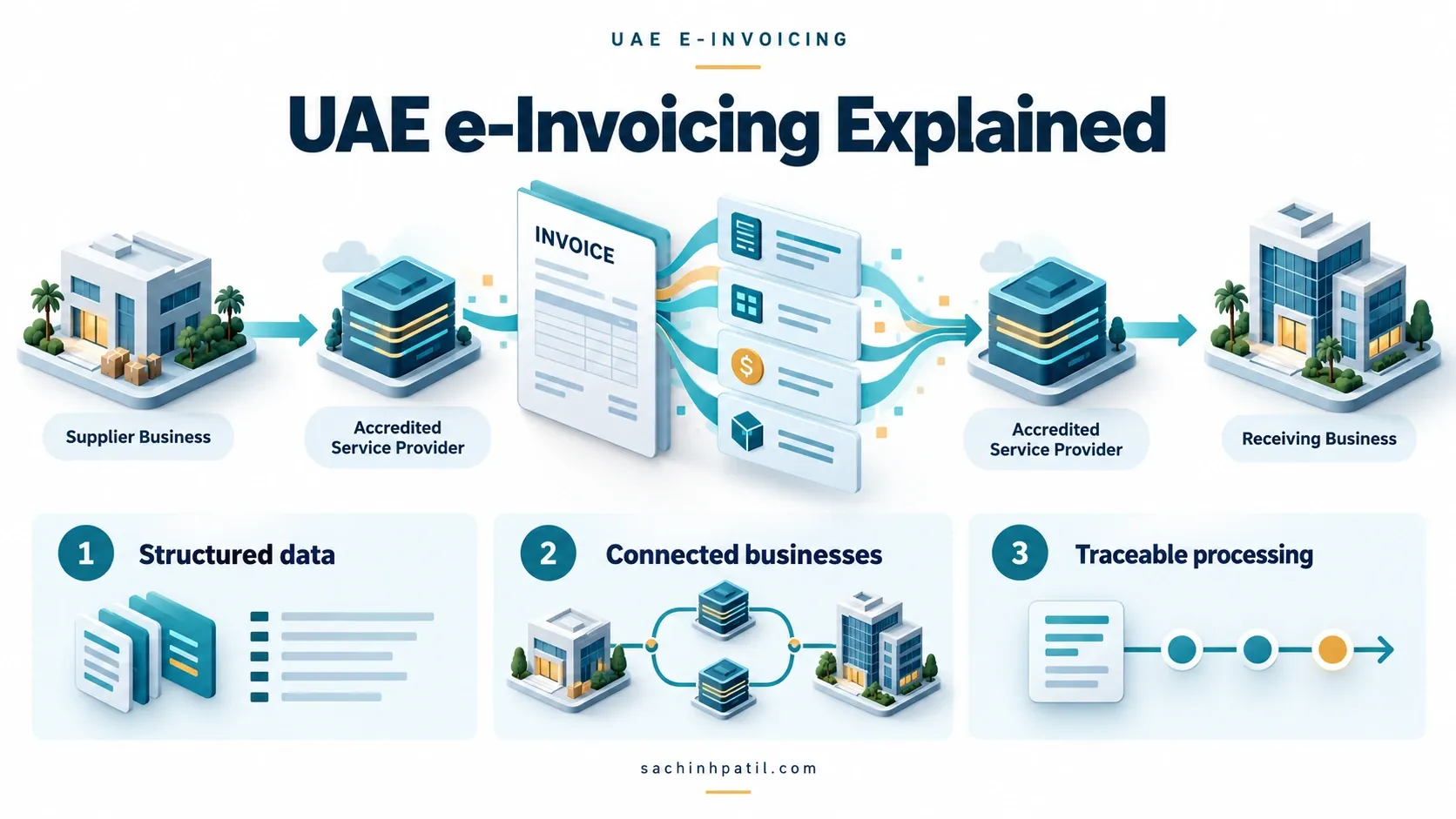
That change is bigger than a document-format upgrade. It introduces a new operating model around invoice exchange, tax reporting, participant identity, validation and system readiness. For Finance, Tax, ERP and SAP teams, understanding that ecosystem is the first step toward designing the right solution.
If you are setting up a programme from scratch, first establish the UAE eInvoicing regulatory baseline. This article builds on that foundation and explains how the model works in practical terms.
Quick answer
The UAE has adopted a Peppol-based Decentralized Continuous Transaction Control and Exchange (DCTCE) 5-corner model.
The core exchange works like this:
The important point is that the UAE is not using a simple model where every ERP sends an invoice directly to the FTA for central clearance. The invoice is exchanged between supplier and buyer through their ASPs, while required Tax Data is reported to Corner 5, the FTA.
Official reference: UAE Ministry of Finance — eInvoicing
What is eInvoicing in the UAE?
The Ministry of Finance describes an eInvoice as structured invoice data issued and exchanged electronically between a supplier and a buyer and reported electronically to the FTA.
That definition immediately separates an Electronic Invoice from a document that merely happens to be digital.
- Word document
- Scanned invoice
- Image
- Email containing invoice information
- Issued through the Electronic Invoicing System
- Transmitted electronically
- Received electronically
- Supports automatic electronic processing
- Follows UAE Electronic Invoicing requirements
The UAE Electronic Invoicing Guidelines further state that Electronic Invoices are issued, transmitted and received in XML format. The content requirements are defined through Peppol PINT-AE.
So the target is not “make the invoice look electronic”. The target is to make the invoice data interoperable and machine-processable.
Official references:
From post-audit thinking to continuous transaction controls
Traditional tax compliance has often relied heavily on periodic reporting and later verification. An invoice is created and exchanged between parties, accounting entries are posted, tax returns are filed, and the tax authority may review the underlying records later through audits or other controls.
Electronic Invoicing changes the timing and structure of that information flow.
The UAE programme explicitly identifies the selected model as Decentralized Continuous Transaction Control and Exchange (DCTCE). The Electronic Invoicing Guidelines also place the programme in the broader context of Continuous Transaction Controls (CTC) and Digital Reporting Requirements.
This does not mean the FTA is positioned as a central invoice-clearing gateway between supplier and buyer.
That distinction matters.
Central clearance vs the UAE decentralized model
| Question | Central clearance concept | UAE DCTCE 5-corner model |
|---|---|---|
| Does the invoice exchange depend on a central tax platform sitting between seller and buyer? | Typically yes | No |
| Who exchanges the Electronic Invoice? | Often supplier → central platform → buyer | Supplier ASP → Buyer ASP |
| Does the tax authority receive transaction information? | Yes | Yes, through Tax Data reporting to Corner 5 |
| Is the supplier/buyer network decentralized? | Not necessarily | Yes, through the Peppol-based ASP model |
| Is the FTA the buyer’s Access Point? | No | No |
For architects, this means invoice exchange and tax reporting should be understood as connected processes, but not collapsed into one generic “send to FTA” interface.
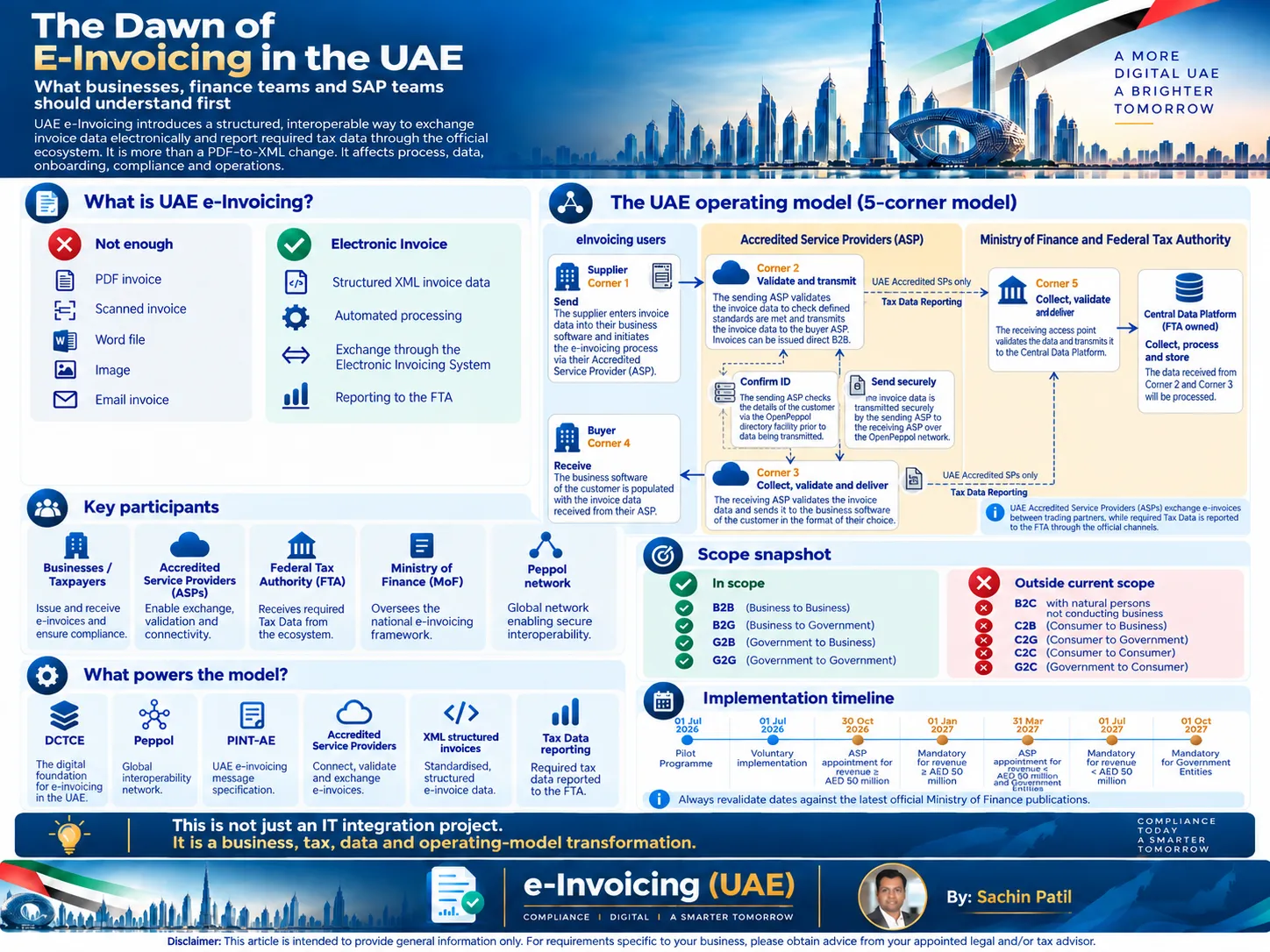
Why Peppol sits at the centre of the ecosystem
Peppol provides an interoperability framework for exchanging standardized electronic business documents between participants.
In the UAE model, businesses do not need to build a unique point-to-point connection to every trading partner. They connect through their ASPs, which participate in the Peppol network.
Think of the difference this way:
The UAE has adopted PINT-AE, which adapts the Peppol International Invoice approach to UAE requirements while retaining interoperability.
The official guidelines define PINT-AE as the UAE’s implementation of the Peppol International methodology, with the State’s requirements defined in the corresponding data dictionary.
Meet the five corners
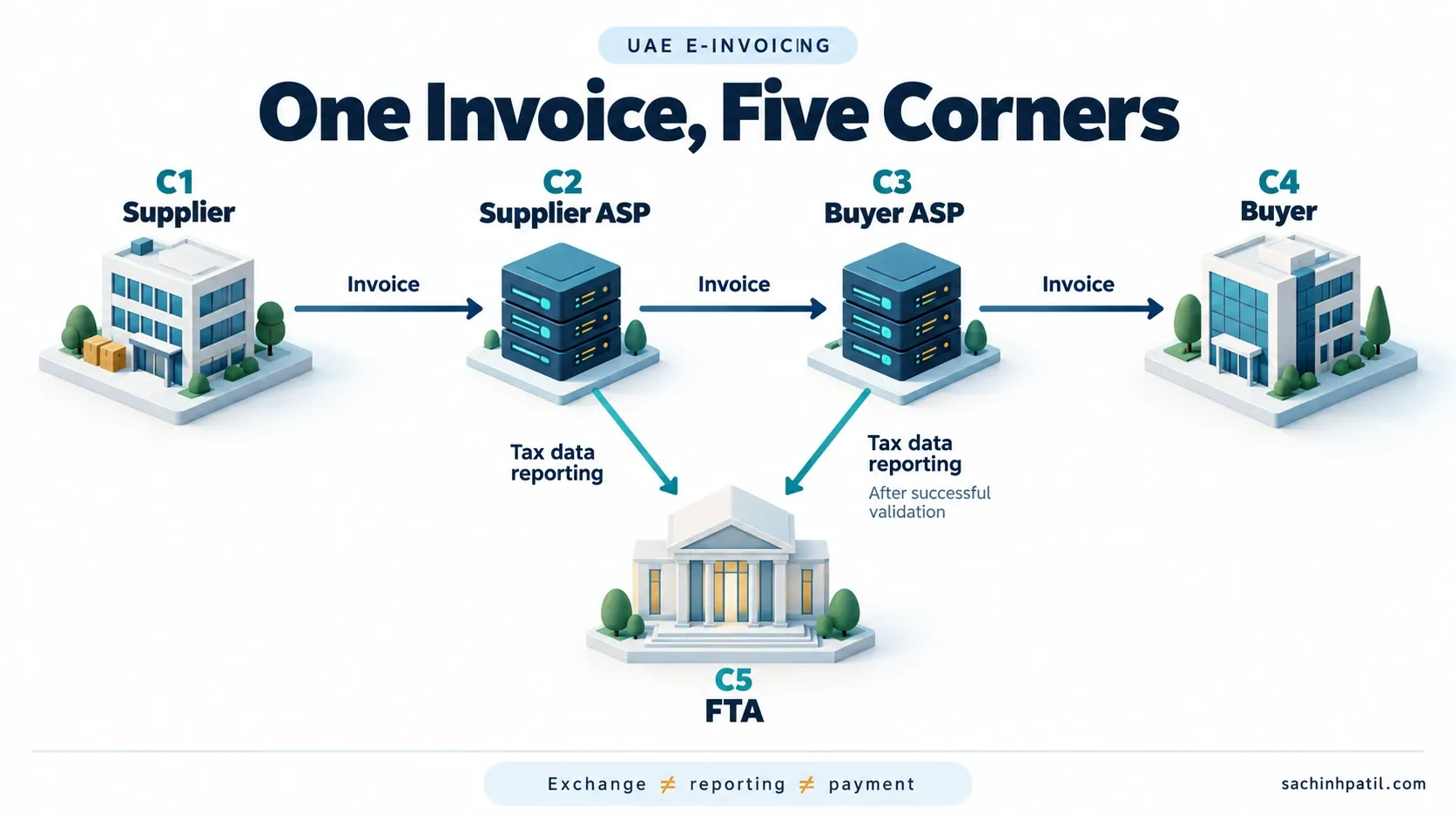
The five corners are more than labels on an architecture diagram. Each one has a distinct role.
Corner 1 — Supplier
The Supplier creates the underlying business invoice data and submits the Electronic Invoice data to its ASP in an agreed format.
From a business and ERP perspective, Corner 1 is where the source transaction begins. This is where the quality of master data, tax determination, invoice totals and transaction classification first matters.
The supplier remains responsible for its compliance obligations even where operational activities are carried out by the ASP.
Corner 2 — Supplier’s Accredited Service Provider
Corner 2 performs several important functions in the official process:
- receives Electronic Invoice data from the supplier;
- validates the data;
- converts it into the UAE standard XML format when the supplier provided another agreed format;
- transmits the Electronic Invoice to Corner 3;
- reports the required Tax Data to Corner 5;
- generates the UUID required for each Electronic Invoice;
- provides and forwards relevant confirmation/status messages.
This is why an ASP should not be treated as a simple network pipe.
Corner 3 — Buyer’s Accredited Service Provider
Corner 3 receives the Electronic Invoice from Corner 2 and validates it.
On successful validation, Corner 3:
- sends a Message Level Status (MLS) back to Corner 2;
- delivers the Electronic Invoice to Corner 4 in an agreed format;
- reports the required Tax Data Document (TDD) to Corner 5.
If validation is unsuccessful, the official model calls for a negative MLS to be reported, and Corner 3 does not perform the normal successful TDD reporting for that validation outcome.
Corner 4 — Buyer
The Buyer receives the Electronic Invoice through its ASP.
The buyer side matters just as much as outbound invoicing. A complete enterprise programme must therefore think about both:
- Accounts Receivable / outbound Electronic Invoices
- Accounts Payable / inbound Electronic Invoices
A business within scope appoints its ASP for both sending and receiving Electronic Invoices.
Corner 5 — Federal Tax Authority
Corner 5 is the FTA.
The FTA receives the required Tax Data reporting from the ASPs and returns the relevant reporting status. The current Ministry of Finance process uses the term Tax Data Document (TDD) for the reported tax dataset and Message Level Status (MLS) for status messages.
Follow one Electronic Invoice through the five-corner model
Use the journey below to see what happens at each stage.
The Supplier sends Electronic Invoice data to its ASP in an agreed format. The source data must already reflect the business transaction correctly.
The full official flow can be summarized as:
Official reference: UAE Ministry of Finance — eInvoicing process
Who are the main participants?
The 5-corner diagram shows the transaction flow, but the wider ecosystem includes several participants with different responsibilities.
| Participant | Primary role in the UAE eInvoicing ecosystem |
|---|---|
| Person / taxpayer / business | Comply with Electronic Invoicing obligations, maintain correct business data, appoint an ASP, exchange and receive Electronic Invoices |
| Government Entity | Same framework applies where the Government Entity is in scope, subject to applicable rules and exclusions |
| Accredited Service Provider | Onboarding support, participant setup, invoice validation, secure exchange, Tax Data reporting, status handling and technical support |
| Ministry of Finance | Regulatory framework, policy, standardization, ASP accreditation and UAE Peppol Authority responsibilities |
| Federal Tax Authority | TIN/TRN registration, onboarding enablement through EmaraTax, infrastructure support, compliance monitoring and Tax Data analysis |
| OpenPeppol / Peppol | Interoperability framework, specifications, access-point requirements and governance |
Ministry of Finance vs Federal Tax Authority
These two roles are often mixed together in project discussions.
The official guidelines distinguish them.
Ministry of Finance responsibilities include:
- establishing the regulatory framework;
- developing and maintaining standards;
- accrediting Service Providers;
- monitoring compliance;
- coordinating with Peppol.
FTA responsibilities include:
- registering Persons and generating TINs/TRNs;
- supporting ASP accreditation testing;
- facilitating onboarding through EmaraTax;
- supporting the required infrastructure;
- monitoring compliance;
- analysing Electronic Invoice data for tax-related purposes.
For implementation teams, this distinction helps when deciding where to look for authoritative information and which process is being discussed.
What is an Accredited Service Provider?
An ASP is a Service Provider that has been accredited by the Ministry of Finance to provide Electronic Invoicing Services in the UAE.
The Ministry publishes and periodically updates the official list of Accredited Service Providers.
Current official list: UAE eInvoicing Accredited Service Providers
A business should not select an ASP only by asking, “Can you connect to SAP?”
The official guidance itself highlights broader considerations such as:
ASP selection is therefore a combination of compliance, architecture, operations and commercial fit.
Participant identity: why the TIN matters
Electronic document exchange requires a reliable participant identity.
The official Guidelines define the Tax Identification Number (TIN) as a unique 10-digit identifier. For a Person already registered with the FTA for a tax type, the TIN is the first 10 digits of its TRN.
The UAE Participant Identifier / End Point ID uses the Peppol scheme identifier 0235 with the 10-digit TIN.
0235:<10-digit TIN>
The participant identity is tied to the entity's FTA identity and onboarding.
This is one reason legal-entity design and master data cannot be left until interface testing.
The ASP supports participant onboarding, but the underlying entity information still needs to be correct.
What transactions are in scope?
At a high level, the current UAE Electronic Invoicing scope covers Business Transactions involving businesses and Government Entities, subject to specific exclusions.
| Supplier | Buyer | Transaction | High-level treatment |
|---|---|---|---|
| Business | Business | B2B | In scope |
| Business | Government | B2G | In scope |
| Government | Business | G2B | In scope |
| Government | Government | G2G | In scope |
| Business | Consumer | B2C | Outside scope |
| Government | Consumer | G2C | Outside scope |
| Consumer | Business | C2B | Outside scope |
| Consumer | Government | C2G | Outside scope |
| Consumer | Consumer | C2C | Outside scope |
The important wording in the Guidelines is that supplies to or from natural persons who are not conducting Business are outside the Electronic Invoicing scope.
So the rule should not be simplified to “all individuals are out of scope”. The actual business status and transaction facts still matter.
Specific exclusions also exist for defined sovereign activities, certain airline transactions and specified financial services. Other exclusions may be added through future Ministerial Decisions.
For a deeper source-by-source treatment of scope and exclusions, refer to the UAE eInvoicing regulatory baseline.
Electronic Invoice categories
The Guidelines define six Electronic Invoice categories.
This matters because “invoice” is not one universal technical object. The document category and transaction scenario affect the required content and processing logic.
The Guidelines also clarify that there is no separate Electronic Invoice category for a provisional invoice.
Eight scenarios can influence invoice content
The UAE Guidelines define eight scenarios with specific invoice requirements:
More than one scenario can apply to the same Electronic Invoice.
That becomes important later when ERP data is mapped to PINT-AE. The source system must be able to identify the business context, not merely provide invoice totals.
The rollout is phased
Electronic Invoicing is being introduced in phases.
The June 2026 Guidelines show the Pilot Programme and voluntary implementation beginning from 01 July 2026. Mandatory implementation then follows based on Revenue and entity type.
A later official amendment, Ministerial Resolution No. 66 of 2026, changed the first-phase ASP appointment deadline for Persons with Revenue equal to or exceeding AED 50 million from 31 July 2026 to 30 October 2026. The mandatory implementation date of 01 January 2027 remains unchanged.
| Entity | ASP appointment | Mandatory implementation |
|---|---|---|
| Person with Revenue ≥ AED 50,000,000 | 30 October 2026 | 01 January 2027 |
| Person with Revenue < AED 50,000,000 | 31 March 2027 | 01 July 2027 |
| Government Entity | 31 March 2027 | 01 October 2027 |
Official reference: Ministerial Resolution No. 66 of 2026
What changes for a business?
At first glance, the programme may look like an integration requirement. In practice, it touches several operating layers.
The Ministry’s own readiness checklist reflects this breadth. It asks businesses to confirm not only ASP selection, but also ERP data readiness, integration, testing, confirmation messages, hosting/security arrangements and error-resolution governance.
What UAE eInvoicing is — and what it is not
No. The UAE definition requires structured electronic data that supports automatic processing.
No. Supplier-to-buyer exchange runs through the ASP/Peppol model; required Tax Data is reported to Corner 5.
No. Scope is tied to Persons conducting Business Transactions in the UAE, subject to the official exclusions.
No. ERP data, process classification, integration, testing, operations and retention still need to be addressed.
A practical readiness conversation
Before moving into detailed ERP architecture, Finance, Tax and IT should be able to answer a small set of questions together.
Scope
- Which legal entities are in scope?
- Which transactions are B2B, B2G, G2B or G2G?
- Which exclusions or special scenarios apply?
- Are VAT Group intra-group transactions relevant?
Identity and counterparties
- Is the correct TIN available for each entity?
- Has the Peppol Participant Identifier been established?
- Can the business reliably identify whether the buyer is a Business, Government Entity or consumer?
- Is buyer/supplier legal information complete?
ASP and connectivity
- Which Accredited Service Provider will be appointed?
- How will outbound invoice data be transmitted?
- How will inbound Electronic Invoices be received?
- How will MLS and other confirmations flow back into business operations?
ERP and data
- Can the source system generate the mandatory data?
- Can transaction scenarios be derived correctly?
- Are tax categories and UoM data available?
- Can invoice and tax totals be reconciled before transmission?
Operations
- Who monitors failures?
- Who corrects master data?
- Who owns resubmission?
- How are service disruptions handled?
- How are Electronic Invoice records retained and retrieved?
If these questions cannot be answered yet, detailed interface design is too early.
Three actions for implementation teams
1. Separate invoice exchange from tax reporting in the architecture
Model the supplier-to-buyer Electronic Invoice exchange and the Tax Data reporting to the FTA as connected but distinct flows. This will make later status monitoring and reconciliation much clearer.
2. Treat ASP selection as an operating-model decision
Evaluate integration, inbound/outbound support, validation, status handling, security, retention arrangements, service levels and scale. Do not reduce the decision to API availability.
3. Build readiness around source data, not XML generation
PINT-AE transformation is downstream. First confirm that the ERP and master-data landscape can provide the legal, tax and transaction information required to create the Electronic Invoice correctly.
Related practical guides
- UAE e-Invoicing Deadlines: Which Date Applies to Your Business?
- How to Choose a UAE e-Invoicing ASP
- UAE e-Invoicing Master Data
Frequently asked questions
What is UAE eInvoicing?
UAE eInvoicing is the structured electronic issuance, exchange and reporting of invoice data through the UAE Electronic Invoicing System. The invoice must be capable of automatic and electronic processing.
Is a PDF an Electronic Invoice in the UAE?
No. A PDF, Word file, scanned copy, image or email is an unstructured format and is not an eInvoice by itself under the UAE programme.
What does DCTCE mean?
DCTCE stands for Decentralized Continuous Transaction Control and Exchange. It is the model selected by the UAE for Electronic Invoicing and uses a decentralized 5-corner structure.
What are the five corners in UAE eInvoicing?
They are the Supplier (Corner 1), Supplier ASP (Corner 2), Buyer ASP (Corner 3), Buyer (Corner 4) and Federal Tax Authority (Corner 5).
Does the FTA clear the invoice before it reaches the buyer?
The official UAE model describes Electronic Invoice exchange between the supplier and buyer through Corners 1–4, while required Tax Data is reported to the FTA as Corner 5. The model should therefore not be described as a simple central-clearance flow.
What is an Accredited Service Provider?
An ASP is a Service Provider accredited by the UAE Ministry of Finance to provide Electronic Invoicing Services in the UAE, including functions around onboarding, validation, secure exchange, reporting and technical support.
What is PINT-AE?
PINT-AE is the UAE adaptation of the Peppol International Invoice methodology. It defines UAE-specific electronic document requirements while maintaining Peppol interoperability.
When does mandatory UAE eInvoicing begin?
For Persons with Revenue equal to or exceeding AED 50 million, mandatory implementation is 01 January 2027. Persons below that threshold follow on 01 July 2027, and Government Entities on 01 October 2027, based on the current official timeline.
Official references
- UAE Ministry of Finance — eInvoicing portal
- UAE eInvoicing Accredited Service Providers
- UAE eInvoicing Programme Introduction — 09 February 2026
- UAE Electronic Invoicing Guidelines — official Ministry of Finance eInvoicing portal
- UAE Electronic Invoice Mandatory Field Requirements — official Ministry of Finance eInvoicing portal
- Ministerial Resolution No. 66 of 2026 — implementation timeline amendment
- OpenPeppol — UAE electronic document specifications
Disclaimer: this article is to provide you the general info for your business specific requirements, get the advise from your appointed legal advisor.
Frequently asked questions
What is a UAE Electronic Invoice?
It is structured invoice data that moves through the UAE Electronic Invoicing System, so it can be processed electronically, exchanged between businesses through Accredited Service Providers and reported to the Federal Tax Authority. It is not simply a PDF sent by email.
Who are the five corners in the UAE eInvoicing model?
C1 is the supplier, C2 the supplier ASP, C3 the buyer ASP, C4 the buyer, and C5 the FTA. The supplier ASP validates, transforms and exchanges, the buyer ASP validates and delivers, and the FTA receives required Tax Data from the ASPs.
Does the ERP send invoices directly to the FTA in the UAE?
No. The UAE is not using a model where every ERP sends an invoice directly to the FTA for central clearance. The invoice is exchanged between supplier and buyer through their ASPs, while required Tax Data is reported to Corner 5.
Continue your trail
You now have the E-Invoicing context.
Save this guide, continue to the next concept or return to the Knowledge Library with your context intact.
E-Invoicing
14 resources in this area.

Practical SAP notes, structured for review, reuse and long-term maintenance.
Working on an FI-CA or IS-U implementation? I take on a limited number of advisory and architecture engagements.
Get in touch →