
“The invoice is valid” is useful only when the team can explain which checks passed. A document can be readable XML and still contain missing business information, an invalid controlled value or inconsistent totals.
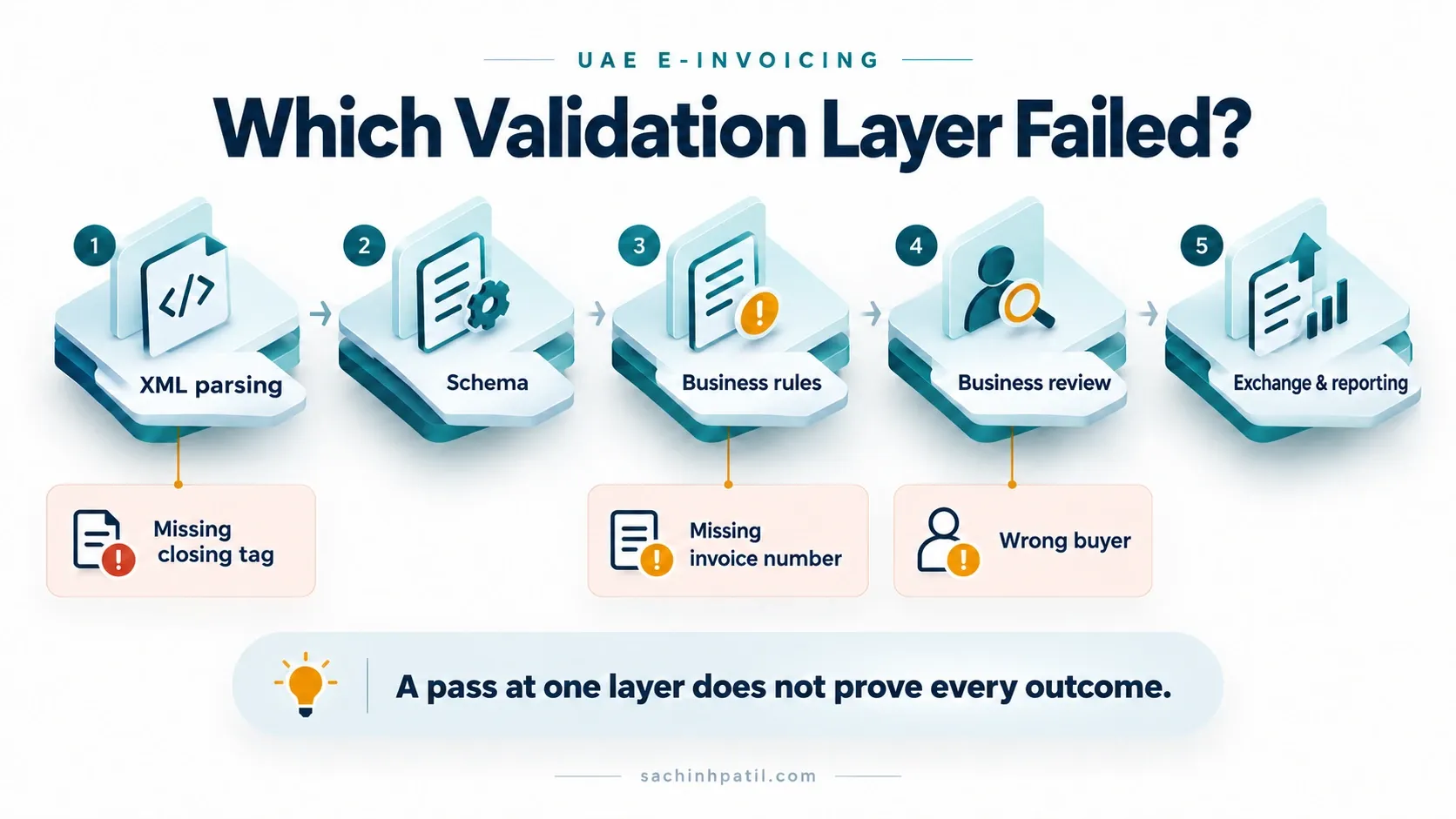
Use validation results as specific evidence. Name the document profile, artefact version, check layer and result.
Understand the layers
| Layer | What the review addresses | Example failure |
|---|---|---|
| XML parsing | Whether the XML is well formed | Missing closing tag |
| Schema | Structural requirements of the applicable schema | Invalid element placement |
| Semantic/business rules | Required content and relationships | Missing invoice number |
| Controlled values | Permitted values for a defined field | Unsupported currency or unit value |
| Business review | Accuracy of the actual transaction | Wrong legal buyer |
| Exchange/reporting | What happened after processing and transmission | Missing or unsuccessful response |
This is an explanatory model, not a claim that every product exposes the same sequence or labels.
Example 1: an invoice number is absent
The published PINT-AE rules identify IBR-002 for the invoice-number requirement. If the number is absent, trace it back to the source and extraction. A generated substitute should not conceal the loss of the real business identifier. Official rule catalogue.
Ask whether the source lacked the value, the extract omitted it or the transformation wrote it in the wrong place. Those causes belong to different fixes.
Example 2: the amount due is inconsistent
Use synthetic values: total including tax AED 1,050, paid amount AED 200 and rounding zero. The expected amount due is AED 850.
IBR-CO-16 defines the relationship among those terms. If the output still says AED 1,050 due, inspect prepayment handling rather than merely changing the displayed total. Official calculation rule catalogue.
Retest the affected mapping and another invoice without a paid amount, so the correction does not introduce a new regression.
Example 3: a local unit has no approved target value
A local source abbreviation may be meaningful to the billing team but unsuitable as the target controlled value. Review the unit’s meaning and map it to the applicable UAE code list. Do not select a code just because its label looks similar. UAE code lists.
Turn messages into owned corrections
Record the source document, payload version, rule/message, check layer, responsible team, correction and retest outcome. Preserve the original evidence so the team can demonstrate what changed.
Avoid grouping every failure under “ASP error”. A source-data issue, an internal mapping defect and a provider-processing incident require different owners.
What an educational simulator can establish
The site’s simulator discloses a bounded set of local checks and simulated process stages. It does not claim complete official XSD/Schematron execution, live FTA submission or certification. Use it to explore scenarios and understand corrections, then use the project’s proper test tooling for its defined validation scope. Simulator scope.
Does a technical pass establish the tax treatment? It does not establish the business facts behind the classification.
Should every failed document be resent immediately? Establish the outcome, cause and controlled recovery before retrying.
Next step: explore a sample in the educational simulator and continue to the monitoring guide.
Reference diagram
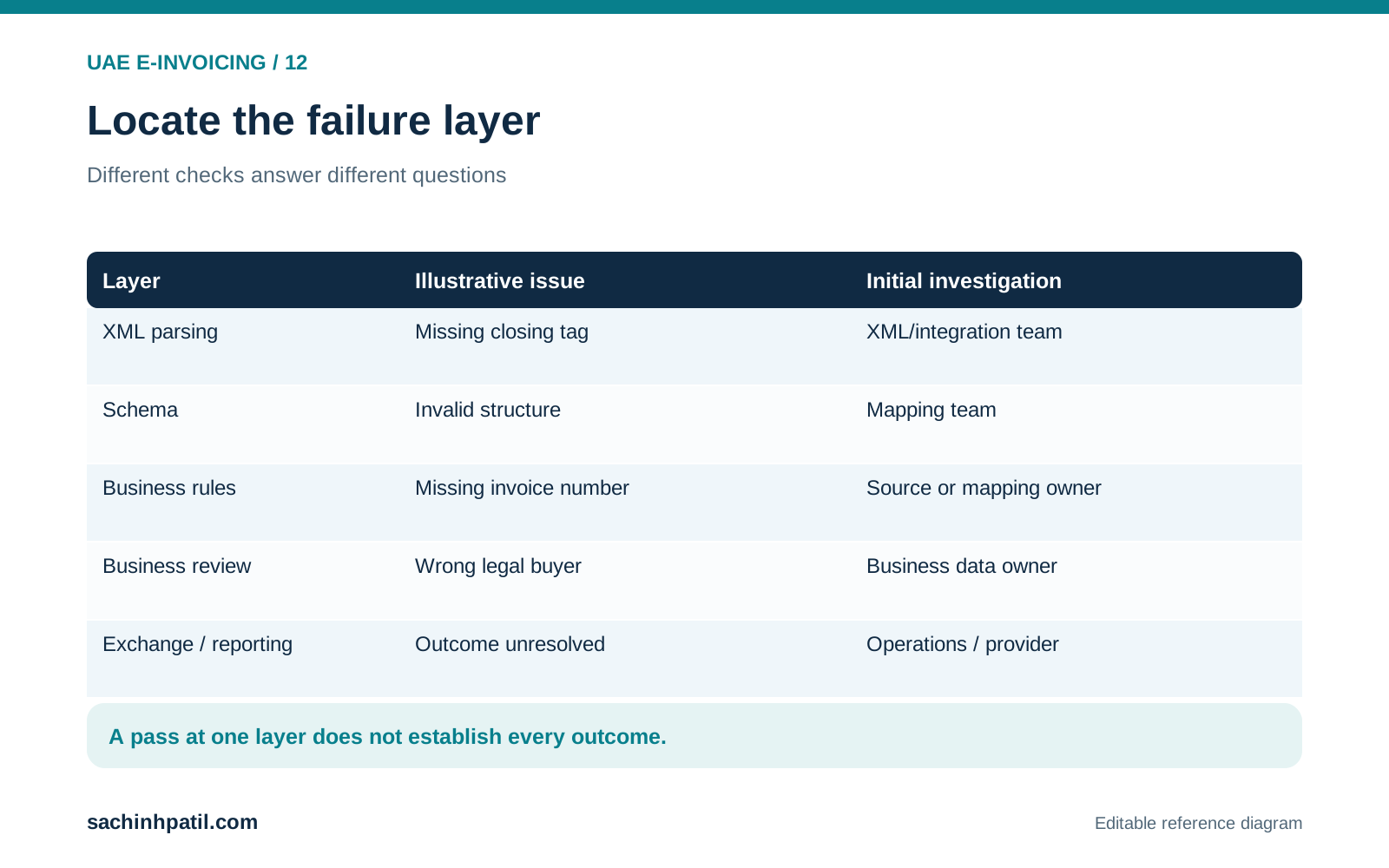
Locate the failure layer before assigning the correction.
Frequently asked questions
Does a technical pass establish the tax treatment?
It does not establish the business facts behind the classification.
Should every failed document be resent immediately?
Establish the outcome, cause and controlled recovery before retrying.
Continue your trail
You now have the e-Invoicing context.
Save this guide, continue to the next concept or return to the Knowledge Library with your context intact.
e-Invoicing
3 resources in this area.

Practical SAP notes, structured for review, reuse and long-term maintenance.
Working on an FI-CA or IS-U implementation? I take on a limited number of advisory and architecture engagements.
Get in touch →