
Two providers quote different monthly fees. Which is cheaper for your business?
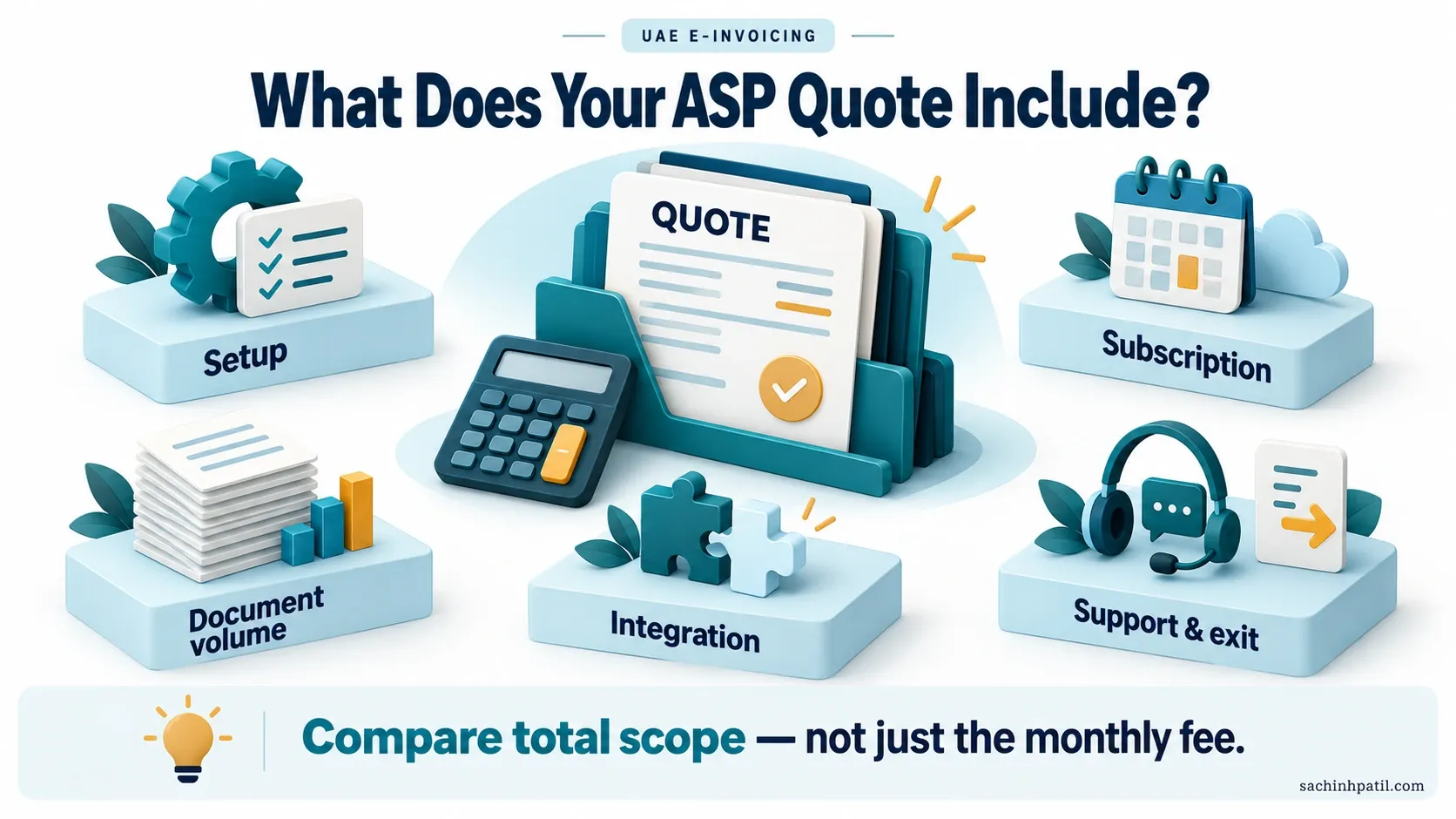
You cannot answer reliably until the quotes cover the same entities, document types, volumes, integration work and service expectations. A lower recurring fee may sit beside a higher setup cost or more work for your internal team.
Use a structured comparison that separates provider charges from the cost of preparing and operating your own processes.
Build the cost model
| Cost area | Questions to resolve |
|---|---|
| Setup and onboarding | Is the charge per entity, environment, interface or project? |
| Subscription | What service and volume does the recurring fee include? |
| Document charges | How are inbound invoices, credit notes and additional volume counted? |
| Integration | Who builds extraction, transformation, connectivity and response handling? |
| Testing | Who supplies environments and supports exception scenarios? |
| Support | What hours and escalation commitments are included? |
| Data access and exit | What retrieval, export or migration work may be charged? |
| Internal effort | Who cleans data, reviews tax logic, tests and supports operations? |
Get each answer in writing. “Included” is meaningful only when the deliverable and its boundaries are clear.
A worked comparison
The following figures are illustrative, use AED, assume a 12-month subscription and exclude VAT. They are not quotations or estimates of prevailing UAE prices.
| First-year item | Provider A | Provider B |
|---|---|---|
| Setup | 6,000 | 2,000 |
| Monthly subscription | 900 | 1,400 |
| Subscription for 12 months | 10,800 | 16,800 |
| Assumed additional document charges | 2,400 | 0 |
| Assumed integration effort | 8,000 | 10,000 |
| Comparable first-year total | 27,200 | 28,800 |
Do not add the monthly row again when calculating the total; it is shown to explain the annual subscription row. In this example, A’s total is AED 1,600 lower. That result holds only for these assumptions and a genuinely comparable scope.
If the zero document-charge assumption for B is unproven, mark it unresolved. A blank commercial answer should not become a free service in the comparison.
Test normal and peak volume
Ask whether the proposal still works when the organisation adds an entity, increases invoice volume or runs a large month-end batch. Review tier boundaries and any minimum commitments.
Use the same volume assumptions in every quote. Mixing outbound-only counts for one provider with incoming and outgoing documents for another produces an attractive but misleading comparison.
Include the cost of exceptions
Ask who will investigate an incomplete buyer record, a transformation failure and a delayed response. If routine investigation requires specialist developers, reflect that in the operating model and internal resource plan.
A useful demonstration shows a business user identifying an issue and the appropriate team correcting it. This gives procurement more information than a headline fee alone.
Review more than year one
Separate one-off charges from recurring costs. Review renewal terms, notice periods, data export and the effort of switching providers. Ask whether a new source system or major interface change becomes a separately priced project.
Validate current accreditation independently through the official provider register. Accreditation and the economics of a particular proposal answer different questions.
Next step: use the 15-question ASP checklist alongside this cost model. Keep unresolved assumptions visible until the provider confirms them.
Reference diagram
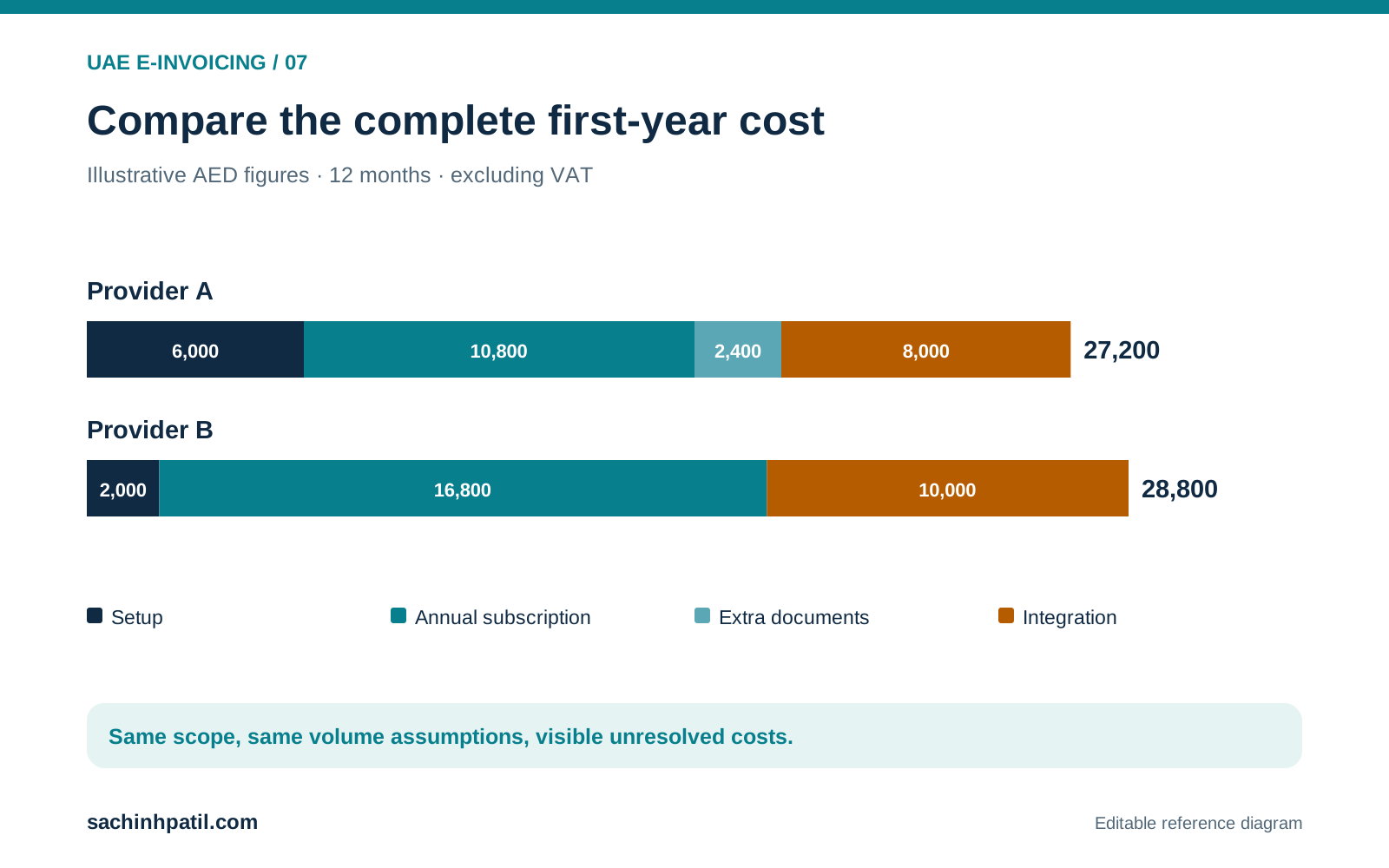
Compare the complete first-year scope; the subscription is one component.
Continue your trail
You now have the E-Invoicing context.
Save this guide, continue to the next concept or return to the Knowledge Library with your context intact.
E-Invoicing
14 resources in this area.

Practical SAP notes, structured for review, reuse and long-term maintenance.
Working on an FI-CA or IS-U implementation? I take on a limited number of advisory and architecture engagements.
Get in touch →