
In a high-volume billing landscape, the document a customer sees may combine information from several processing stages. Before designing UAE e-invoicing extraction, identify which stage contains each required business fact.
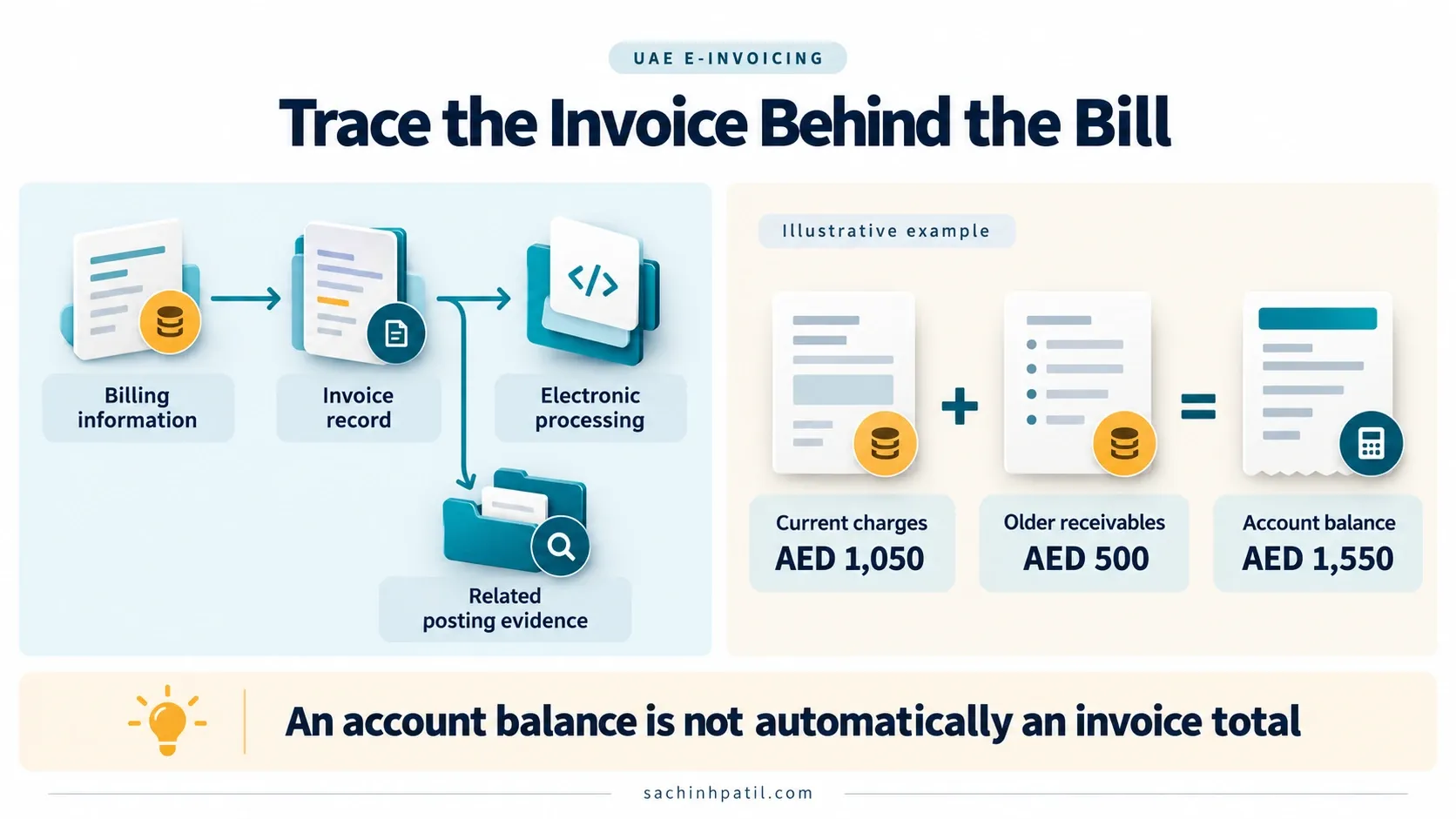
An accounting balance, a billing result, an invoicing document and a customer-facing presentation can answer different questions. Treating them as interchangeable creates avoidable mapping and reconciliation problems.
Establish the document relationships
SAP’s Convergent Invoicing documentation describes collecting billing information into customer invoices and posting invoice amounts to FI-CA. Related process documentation distinguishes billing documents, invoicing documents and posting information. SAP Convergent Invoicing, invoicing processes.
Those process concepts help frame the design. They do not, alone, establish the supported UAE eDocument source route for your specific industry system and release.
Build a lineage table
| Business concept | Question for the design team |
|---|---|
| Billed service | Where are service, period, quantity and price established? |
| Invoice identity | Which document is the authoritative invoice record? |
| Current charge | Which values belong to this invoice? |
| Account position | Which displayed values relate to other receivables or payments? |
| Adjustment | How does a correction relate to the original billing/invoice chain? |
| Electronic processing | Which supported source event creates the intended electronic record? |
| Reconciliation | How are related documents linked across stages? |
Document exact relationships in the intended product configuration. Do not select an extraction point simply because it already feeds the print form.
Distinguish current invoice amounts from account balances
Use a synthetic customer statement showing AED 1,050 of current invoice charges and AED 500 of older unpaid receivables. The displayed account balance is AED 1,550.
The mapping team needs to establish the intended meaning of each target monetary term. Copying the statement balance into an invoice-total field without that review can mix different business populations.
Test the relationship with Finance using source records. The target treatment depends on the actual business document and applicable rules, not this teaching example.
Review business and consumer classification
A Utilities or BRIM customer population can contain materially different transaction streams. Use the scope assessment to govern classification. Do not infer legal treatment from an account-number range or print-layout choice without an approved business rule.
Include rebilling and adjustments
Trace an original invoice and a subsequent correction through the source chain. Establish which supported business process creates the correction, how references are preserved and how operations distinguishes the new document from a repeated transmission.
Reconciliation needs to explain both the original and adjusting records. A daily count of outgoing files alone may conceal a document that was reversed or superseded internally.
Test the billing window
Use a representative batch profile, including exceptional records and correction work. Measure whether support can locate incomplete cases while the normal run continues.
Record throughput evidence using the tested environment and workload. Do not extrapolate a successful single invoice into an unsupported volume claim.
Confirm product coverage before committing the design
Review source-process support, relevant product/release documentation and the planned integration route with the implementation team. Where standard coverage is unproven, record it as a design dependency rather than quietly presenting a custom route as delivered functionality.
Next step: combine the SAP architecture review with the UAT catalogue, adding the industry-specific document chains that matter to your organisation.
Reference diagram
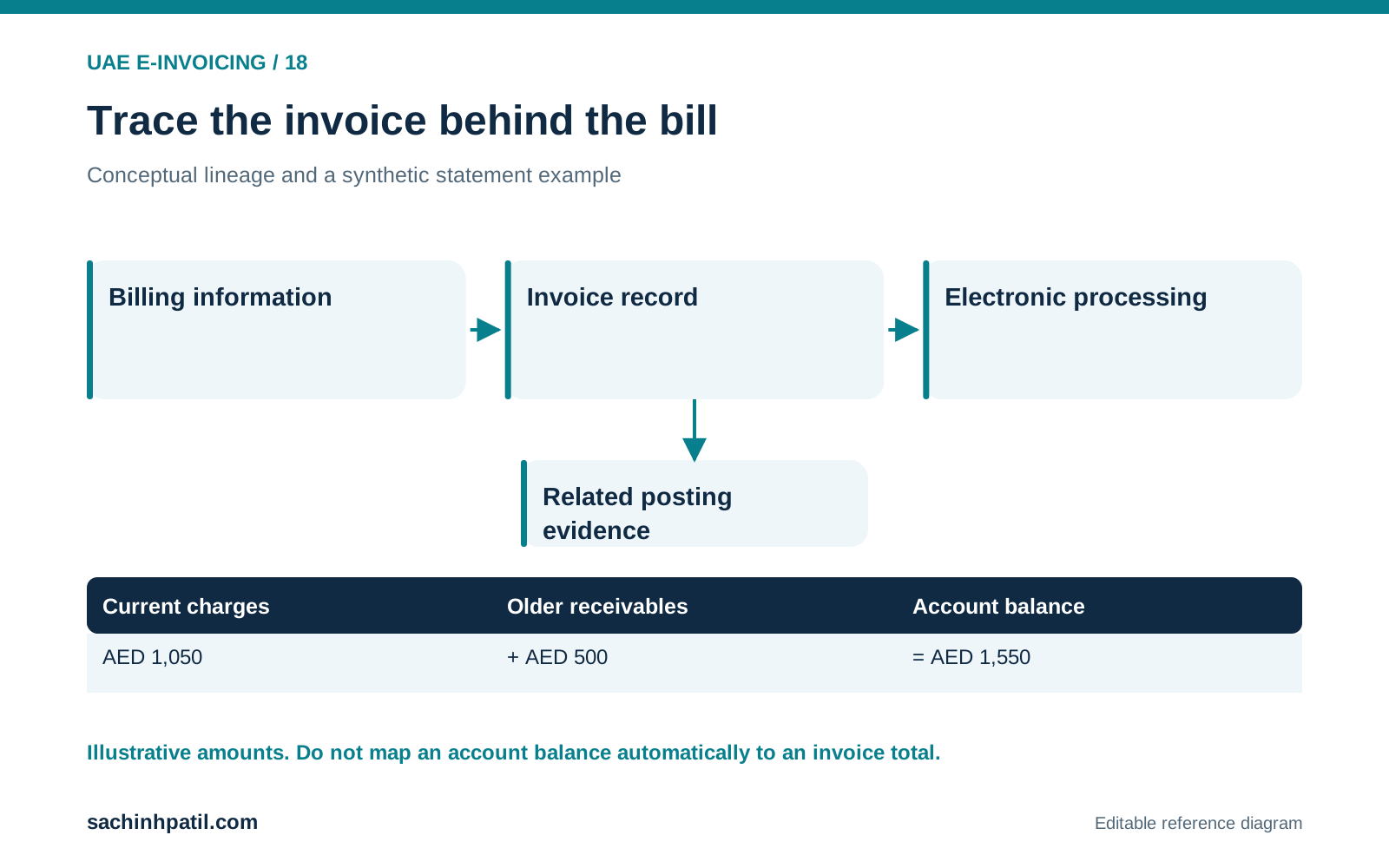
Establish the source meaning before selecting a target invoice amount.
Continue your trail
You now have the E-Invoicing context.
Save this guide, continue to the next concept or return to the Knowledge Library with your context intact.
E-Invoicing
14 resources in this area.

Practical SAP notes, structured for review, reuse and long-term maintenance.
Working on an FI-CA or IS-U implementation? I take on a limited number of advisory and architecture engagements.
Get in touch →