
For an in-scope business with annual revenue of AED 50 million or more, the ASP appointment deadline is 30 October 2026 and mandatory implementation is 1 January 2027. These are two separate milestones.
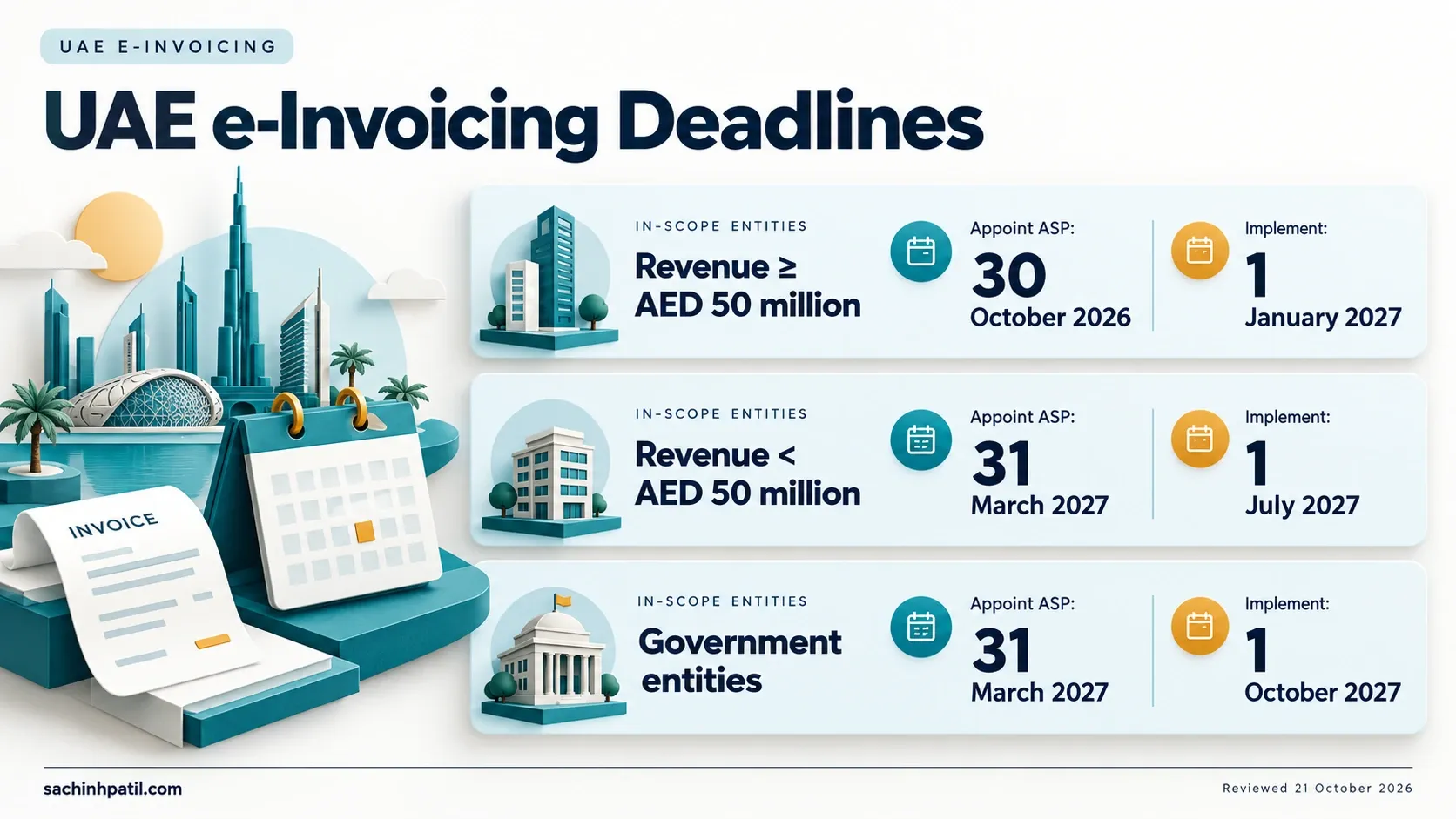
The Ministry extended the original Phase 1 appointment date while retaining the January implementation date. Its more recent awareness update confirms the AED 50 million-or-more threshold. MoF amendment, recent rollout confirmation.
The implementation timetable
| In-scope category | Appoint an ASP by | Mandatory implementation |
|---|---|---|
| Revenue at least AED 50 million | 30 October 2026 | 1 January 2027 |
| Revenue below AED 50 million | 31 March 2027 | 1 July 2027 |
| Government entities | 31 March 2027 | 1 October 2027 |
The later-phase dates are set out in the official implementation decision. Applicability and exclusions still need to be assessed for the business and transactions concerned.
What the appointment milestone should trigger
Use the appointment milestone to review the responsibilities that sit between your organisation and the provider. Confirm the onboarding work, the agreed interface, the scenario coverage and the route for unresolved questions.
Avoid treating a provider demonstration as evidence that your own billing systems are ready. Ask the team to process representative business data and explain a failed example as well as a successful one.
| Review area | Evidence to request |
|---|---|
| Business scope | Owned list of entities, systems and scenarios |
| Provider relationship | Current accreditation check and onboarding status |
| Data preparation | Sample records and documented missing values |
| Integration | Agreed payload, connectivity and response design |
| Testing | Executed scenarios and defect ownership |
| Operations | Monitoring, correction and reconciliation instructions |
This table is a project-management aid. The evidence required in a particular programme depends on its scope and delivery arrangements.
Build the implementation plan backward
Start with the date by which normal operations need to work. Then identify what must be proven before that point: source data, mappings, connectivity, end-to-end tests, business training and support cover.
Record dependencies between tasks. A test team cannot meaningfully verify the buyer-routing process if the onboarding identity is unresolved. A mapping cannot be signed off if the tax treatment is still awaiting a decision.
Give each dependency one owner and an evidence-based completion condition. “Integration in progress” provides little useful information. “Returned exchange and reporting responses linked to the source invoice in the test environment” is easier to assess.
What should smaller businesses do now?
Use the later timetable to compare options calmly and clean up information before implementation pressure builds. Identify the system that actually issues the invoice, estimate normal and peak document volumes, and prepare examples for prospective providers.
A short scenario list can prevent an unsuitable purchase. Include credit notes, recurring billing and foreign currencies where they are part of normal operations.
Questions teams often ask
Does the October appointment date mean January implementation moved? The cited MoF updates distinguish the appointment extension from the unchanged first-phase implementation date.
Should we wait for a possible extension? Base delivery planning on the published timetable. Change it only when an official amendment applies.
What if we are unsure about scope? Resolve that separately using the regulatory baseline.
Next step: use the readiness checklist to assign owners and evidence to the remaining work.
Reference diagram
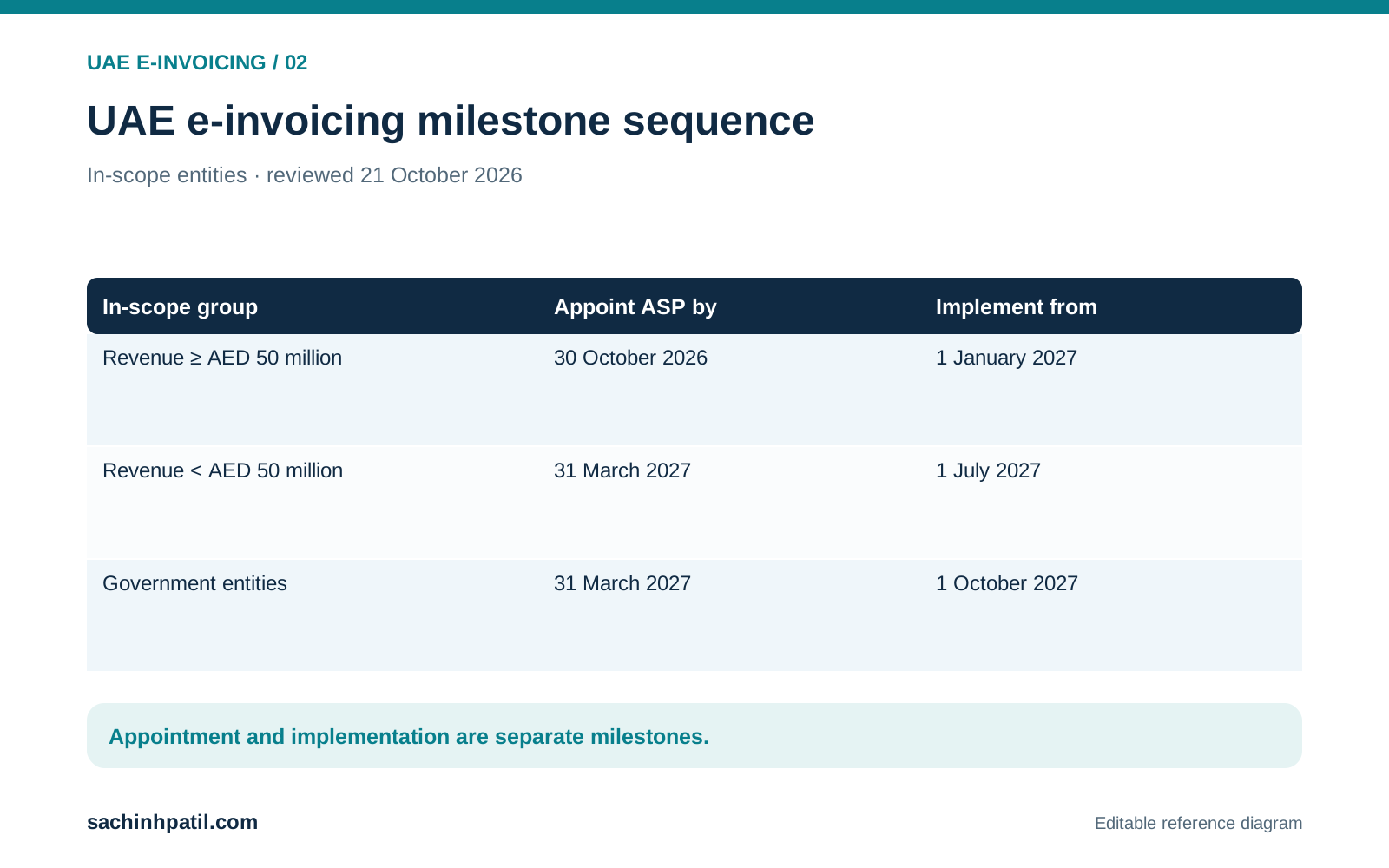
Provider appointment and implementation are separate milestones. Read the table for the dates applicable to each group.
Frequently asked questions
Does the October appointment date mean January implementation moved?
The cited MoF updates distinguish the appointment extension from the unchanged first-phase implementation date.
Should we wait for a possible extension?
Base delivery planning on the published timetable. Change it only when an official amendment applies.
What if we are unsure about scope?
Resolve that separately using the regulatory baseline.
Continue your trail
You now have the E-Invoicing context.
Save this guide, continue to the next concept or return to the Knowledge Library with your context intact.
E-Invoicing
14 resources in this area.

Practical SAP notes, structured for review, reuse and long-term maintenance.
Working on an FI-CA or IS-U implementation? I take on a limited number of advisory and architecture engagements.
Get in touch →