
A successful standard invoice is a starting point for UAT. It does not demonstrate that credit notes, incomplete customer records, delayed responses or a large billing run will work as intended.
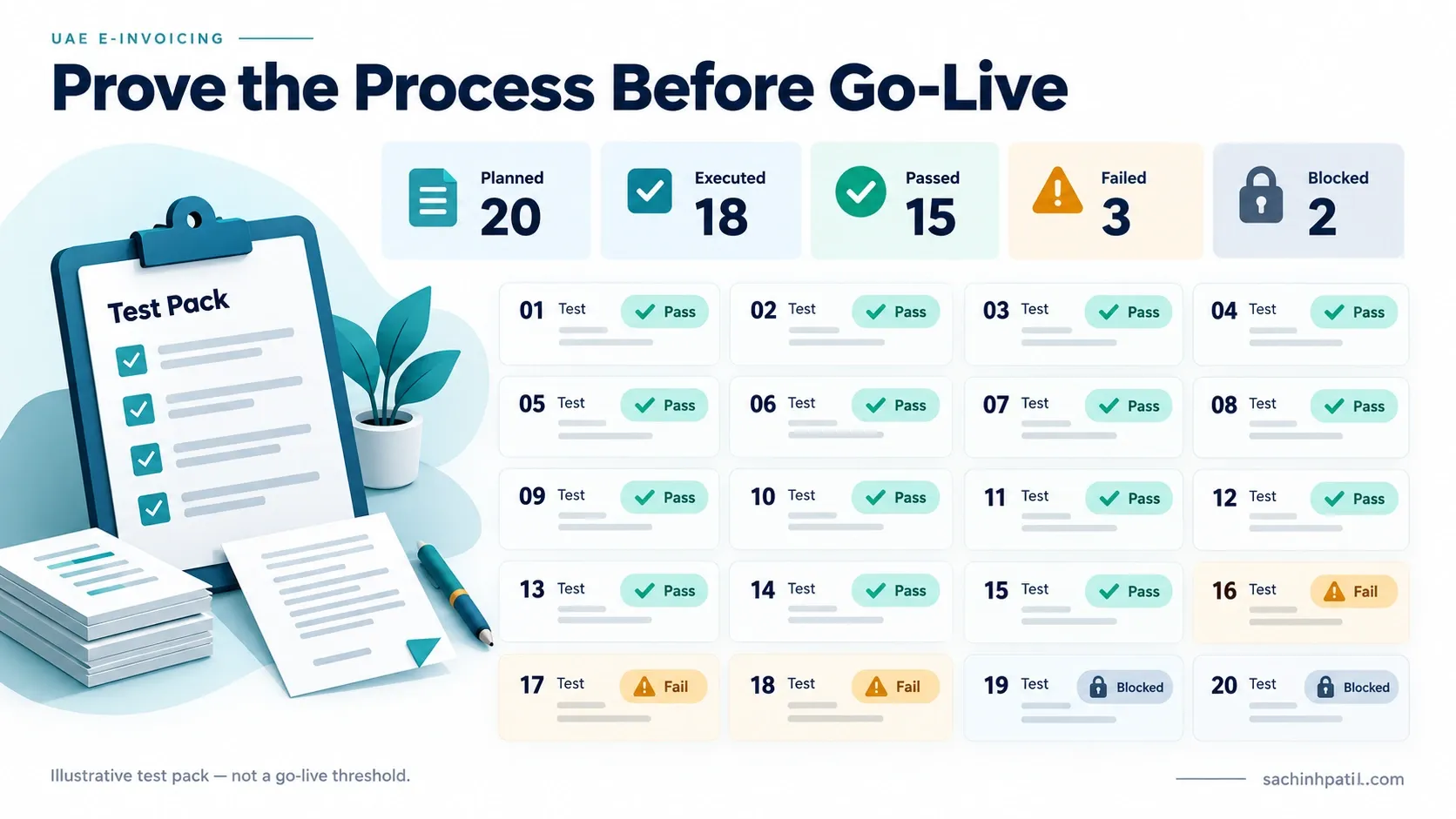
Build the test catalogue from the business scenario inventory and the agreed integration design. Give each case a defined source, expected information, expected response and evidence requirement.
Start with an owned catalogue
| Case | Test focus | Evidence to retain |
|---|---|---|
| Routine outgoing invoice | Complete baseline flow | Source, target and responses |
| Relevant credit note | Category, references and correction process | Original and correcting document trace |
| Foreign currency, if used | Currency, calculations and applicable AED data | Reviewed source and expected amounts |
| Relevant special scenario | Data and classification logic | Approved expected treatment |
| Missing master value | Detection and correction | Failure message and successful retest |
| Invalid controlled value | Mapping/check behaviour | Input, message and correction |
| Unknown communication outcome | Investigation before recovery | Provider outcome evidence |
| Duplicate attempt | Supported duplicate protection | Attempt/correlation history |
| Incoming supplier invoice | Receiving and AP handover | Receipt, match and exception evidence |
| Expected peak load | Capacity and completion visibility | Volumes, timings and reconciliations |
| Record retrieval | Support/audit access | Retrieved document and related evidence |
Tailor the catalogue. Do not add a scenario merely because it appears in a generic list, and do not omit one because it complicates the demonstration.
Specify what “pass” means
Each test should state what is expected at the source, transformation, check and response layers. Include the expected action for a deliberately defective record.
For a negative test, “rejected with the intended actionable message” can be the expected result. Keep that distinct from a positive invoice completing successfully.
A worked test record
Use synthetic case UAT-MD-01: the buyer record lacks an agreed routing value. The expected business behaviour is to detect the missing information, prevent an uncontrolled submission and direct the issue to the accountable owner according to the implementation design.
After correction, generate or reprocess using the supported route. Capture the new data and outcome. Have the business user confirm that the correction process is understandable and repeatable.
Keep the denominator visible
Suppose a test pack contains 20 cases: 15 pass, three fail and two are blocked. Reporting “100% of executed cases passed” would be wrong, and reporting only the 15 passes would hide the incomplete scope.
Show planned, executed, passed, failed and blocked counts using consistent definitions. State which cases are required for the go-live decision. The invented numbers here teach reporting discipline; they are not a recommended pass threshold.
Run a cutover rehearsal
Identify open documents, the scope boundary between old and new processing, outstanding incidents, user access, support contacts and reconciliation responsibility. Test how the team detects missing or duplicate records during the transition.
Agree the conditions for pausing rollout or escalating a problem. Use supported recovery procedures rather than assuming every interface action can be reversed.
Hold an evidence-based go/no-go review
Bring Finance, Tax, IT, operations and the programme decision owner together. Review unresolved items with impact, mitigation and owner. Keep the decision and rationale beside the evidence.
For the external technical baseline, use the official PINT-AE publications. The catalogue in this article is an implementation test method, not an official certification regime.
Next step: use the readiness checklist for the final workstream review and the operations guide for support handover.
Reference diagram
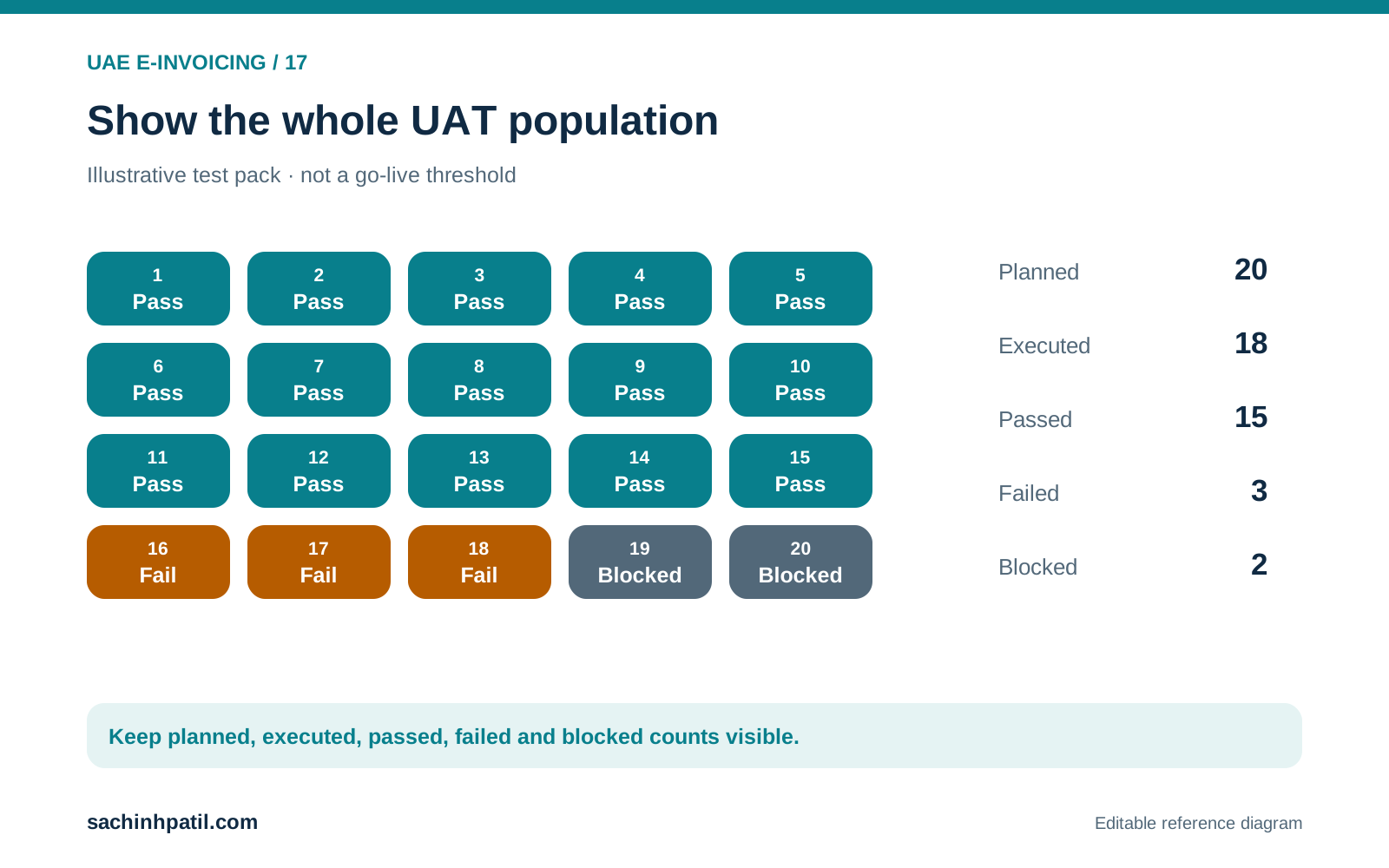
Report the whole planned test population, including failures and blocked cases.
Continue your trail
You now have the E-Invoicing context.
Save this guide, continue to the next concept or return to the Knowledge Library with your context intact.
E-Invoicing
14 resources in this area.

Practical SAP notes, structured for review, reuse and long-term maintenance.
Working on an FI-CA or IS-U implementation? I take on a limited number of advisory and architecture engagements.
Get in touch →