
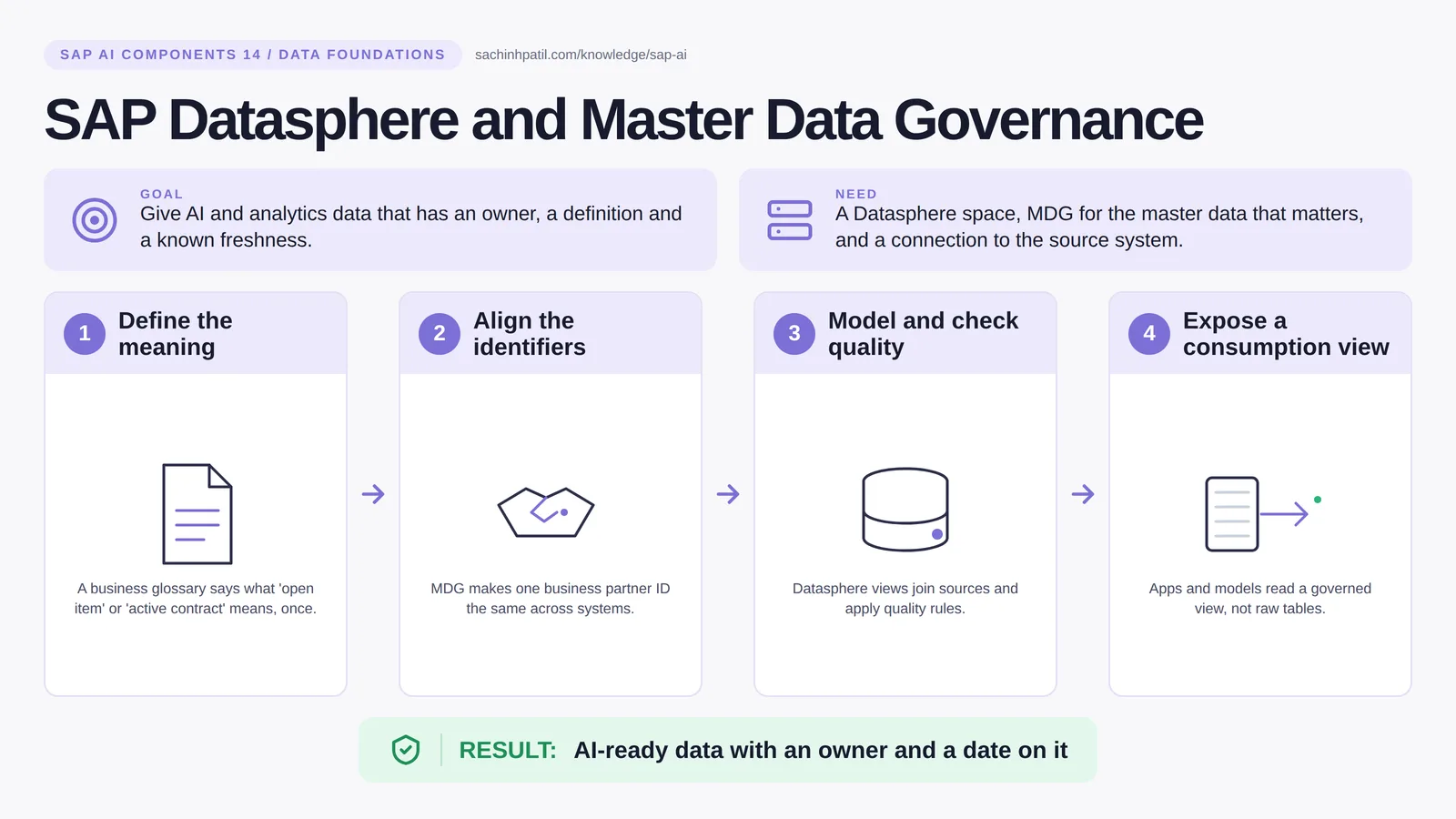
Define the meaning → Align the identifiers → Model and check quality → Expose a consumption view → AI-ready data with an owner and a date on it. A learning overview, not a screenshot of a live system.
Advanced · 9 min read · Part 14 of 17 in SAP AI Components Explained
Most arguments about AI output are really arguments about definitions. Fix ‘what does late mean’ before you train anything.
SAP Datasphere is the focus of this post. Before any model touches your data, three questions need answers: what does this field mean, is this the same customer as that one, and how old is this number. SAP Datasphere answers the first and third with semantic models, lineage and freshness. Master Data Governance answers the second by making one business partner ID mean the same thing everywhere.
By the end you will be able to say in one sentence what SAP Datasphere and Master Data Governance does, draw how data moves through it, and use the design-review line that stops most mistakes: A snapshot is not a live transaction.
SAP Datasphere and Master Data Governance in one sentence
One agreed meaning for ‘customer’ before any AI is allowed near the data.
| Its job | Give AI and analytics data that has an owner, a definition and a known freshness. |
| You need | A Datasphere space, MDG for the master data that matters, and a connection to the source system. |
| Layer | Data foundations |
| Design check | A snapshot is not a live transaction. |
The everyday picture
A city records office and a standards board. The board decides what an address must contain; the records office keeps every address in that shape, with a note on when it was last checked.
Why SAP Datasphere and Master Data Governance exists
Most disputes about AI output are definition disputes. ‘Late payer’ means different things to collections, to finance and to the model that was trained on an extract someone made in March. A governed view with a written definition, a named owner and a refresh timestamp ends the argument before the model starts.
How SAP Datasphere and Master Data Governance works, in four steps
- Define the meaning. A business glossary says what ‘open item’ or ‘active contract’ means, once.
- Align the identifiers. MDG makes one business partner ID the same across systems.
- Model and check quality. Datasphere views join sources and apply quality rules.
- Expose a consumption view. Apps and models read a governed view, not raw tables.
In Datasphere you create a space, connect S/4HANA and other sources, and build views that join them, with quality rules and a business glossary. You choose per view whether to read live (federation) or replicate on a schedule, depending on the source and the capabilities available. MDG sits upstream: suppliers and business partners are created once, validated and distributed, so the ID in the warehouse matches the ID in the ERP. Apps and models read a consumption view, not raw tables, and the view carries its own lineage and last-refresh time.
Where it sits in the SAP landscape

One partner ID from MDG; consumers read a governed view with a refresh time.
A worked example, with numbers
Before training a late-payment model, the team writes the definitions: ‘late’ means an open item past its due date by more than 5 days; ‘active contract’ means status A with no future move-out. MDG ensures business partner 300012345 is one record, not three with different bank accounts. Datasphere joins FI-CA history, dunning levels and contract data into a view CollectionsRiskView, replicated nightly at 02:00, with lineage showing the three sources and a last-refreshed stamp. The model trains on that view. When an agent later answers ‘who paid late twice this quarter’, it reads CollectionsRiskView, shows the 02:00 refresh time, and anyone who needs today’s position knows to ask S/4HANA instead. The 02:00 stamp is the freshness limit the answer carries.
How the data flows

The check that actually matters
A view is a snapshot. An agent reading last night’s balance from Datasphere is reading yesterday. For today’s figure, ask S/4HANA. Governance also needs people: a quality rule that fails and has no owner is a report nobody reads. And note the direction of travel: Datasphere is now a core component of SAP Business Data Cloud, which post 17 picks up.
A snapshot is not a live transaction. An agent reading last night’s Datasphere view sees yesterday’s balance. For today’s balance, ask S/4HANA.
SAP Datasphere vs SAP Business Data Cloud
| Question | Option A | Option B |
|---|---|---|
| What it is | A product: warehouse and semantic layer | A platform that includes Datasphere |
| Adds | — | Data products, zero-copy sharing with Databricks and Snowflake |
| Relationship | Datasphere is a core component of BDC | — |
| Plan with | BDC in mind for new landscapes | see post 17 |
What SAP Datasphere and Master Data Governance does, and what it does not
It does
- Datasphere: spaces, semantic models, federation and replication, business catalog.
- MDG: central creation, validation and distribution of master data.
- Lineage and freshness metadata for every view.
It does not
- Fix bad source data. It makes bad data visible and governed.
- Replace the transactional system. Live balances still come from S/4HANA.
- Make a model accurate. It makes the inputs trustworthy.
Three real situations
Collections data foundation. Payment history, dunning levels and contract data are modelled once, with a definition of ‘late’, before a prediction model is trained.
Supplier identity quality. MDG stops the same supplier existing three times with three bank accounts.
Grounded analytical assistant. An assistant answers ‘which customers paid late twice this quarter’ from a governed view, and shows the view’s refresh time.
In practice: what teams get wrong
Datasphere provides spaces, semantic models, federation and replication, a business glossary and a catalog, and it is a core component of SAP Business Data Cloud. Master Data Governance governs the entities that must agree across systems, business partners, suppliers, materials, by centralising creation, validation and distribution. Together they give AI three things models cannot supply themselves: a written definition of each measure, one identifier per real-world entity, and a known freshness on every view. You choose per view between live federation (current but slower) and scheduled replication (fast but as-of a time), and you expose a governed consumption view rather than raw tables.
From the field. I have seen two teams argue for weeks about an AI ‘error’ that was really two definitions of late payer. The model was fine; the glossary was missing.
Other gotchas worth a line:
- Define ‘late’ and ‘active’ in writing; most disputes about AI output are definition disputes.
- Federation is live but slower; replication is fast but stale. Choose per view.
- Quality rules need owners who act on failures.
- Datasphere is a core component of SAP Business Data Cloud, not replaced by it; check the current SAP documentation.
Terms you will hear
| Term | Plain meaning |
|---|---|
| Datasphere | SAP’s data warehouse and semantic layer, part of BDC. |
| Space | A governed area in Datasphere for one team or domain. |
| Semantic model | Business meaning layered over raw tables. |
| MDG | Master Data Governance: one agreed identity per entity. |
| Federation vs replication | Read live, or copy on a schedule. |
| Lineage | Where a value came from and how it was transformed. |
| Data product | A governed, owned, documented dataset. |
Quick self-check
- In one sentence, what is SAP Datasphere and Master Data Governance’s job?
- Which decision does it not make, and who makes it instead?
- What is the one thing you would verify before calling it production-ready?
Show the answers
- Give AI and analytics data that has an owner, a definition and a known freshness.
- Fix bad source data. It makes bad data visible and governed.
- Define ‘late’ and ‘active’ in writing; most disputes about AI output are definition disputes.
Key takeaways
- One agreed meaning for ‘customer’ before any AI is allowed near the data.
- A snapshot is not a live transaction.
- Datasphere: spaces, semantic models, federation and replication, business catalog.
- Fix bad source data. It makes bad data visible and governed.
- Datasphere is a core component of SAP Business Data Cloud, not replaced by it; check the current SAP documentation.
FAQs
Datasphere or Business Data Cloud?
Datasphere is a core component of SAP Business Data Cloud. New landscapes should plan with BDC in mind; see post 17.
Do I need MDG for a small AI project?
You need agreed identifiers. MDG is the tool when several systems disagree about them.
Keep going in the series
Previous: SAP AI Launchpad Next: Joule and Joule for Consultants
Full map: SAP AI Components Explained — 17 posts from platform to agents.
Sources and research notes
Research checked on 21 October 2026. Product names, plans, models and regional availability change fast; the starting reference for this component is SAP Datasphere. Examples use a fictional utility company and fictional cases (amounts, IDs, names); no customer landscape is described.
Recap
SAP Datasphere and Master Data Governance: give AI and analytics data that has an owner, a definition and a known freshness. The result is ai-ready data with an owner and a date on it. The one thing to remember: a snapshot is not a live transaction.
Found this useful? The next post, Joule and Joule for Consultants, builds on it. Share it with the SAP colleague who keeps asking what all these components actually do.
Frequently asked questions
Datasphere or Business Data Cloud?
Datasphere is a core component of SAP Business Data Cloud. New landscapes should plan with BDC in mind; see post 17.
Do I need MDG for a small AI project?
You need agreed identifiers. MDG is the tool when several systems disagree about them.
Further reading
Continue your trail
You now have the SAP AI Components context.
Save this guide, continue to the next concept or return to the Knowledge Library with your context intact.
SAP AI Components
17 resources in this area.

Practical SAP notes, structured for review, reuse and long-term maintenance.
Working on an FI-CA or IS-U implementation? I take on a limited number of advisory and architecture engagements.
Get in touch →