
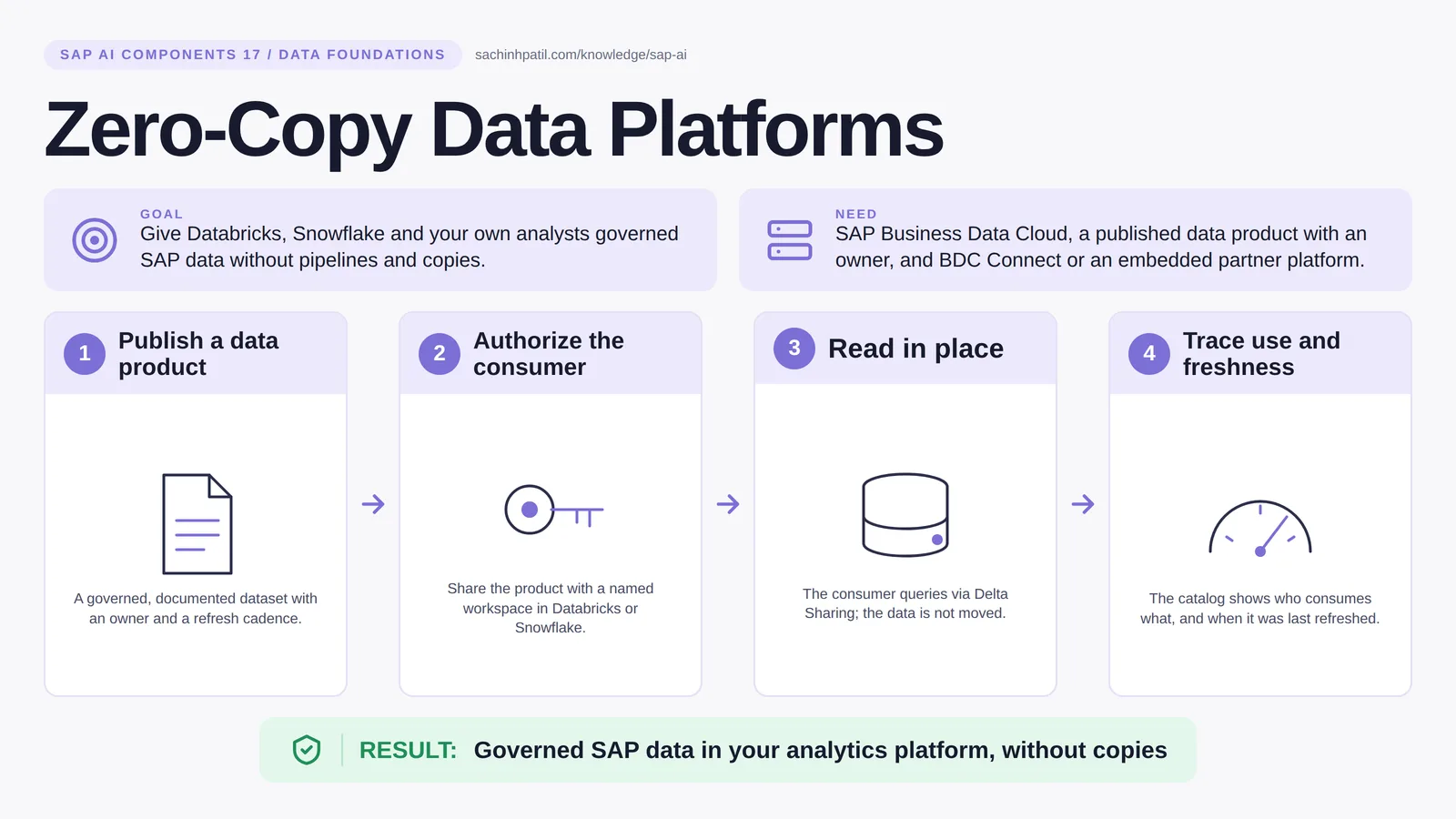
Publish a data product → Authorize the consumer → Read in place → Trace use and freshness → Governed SAP data in your analytics platform, without copies. A learning overview, not a screenshot of a live system.
Advanced · 9 min read · Part 17 of 17 in SAP AI Components Explained
Stop photocopying your SAP data into every analytics tool. Lend it instead, with its meaning attached, and keep one source of truth.
SAP Business Data Cloud zero-copy is the focus of this post. For years, getting SAP data into Databricks or Snowflake meant a nightly extract, a pipeline someone maintained, and a copy that drifted from the source. SAP Business Data Cloud changes the model: SAP publishes governed data products, and the analytics platform reads them in place, through zero-copy sharing built on Delta Sharing, without the data being extracted into a pipeline. Lend the data; do not photocopy it.
By the end you will be able to say in one sentence what Zero-Copy Data Platforms does, draw how data moves through it, and use the design-review line that stops most mistakes: Zero-copy is not zero retention.
Zero-Copy Data Platforms in one sentence
Lend the data, do not photocopy it. Analytics platforms read SAP data products in place.
| Its job | Give Databricks, Snowflake and your own analysts governed SAP data without pipelines and copies. |
| You need | SAP Business Data Cloud, a published data product with an owner, and BDC Connect or an embedded partner platform. |
| Layer | Data foundations |
| Design check | Zero-copy is not zero retention. |
The everyday picture
A shared reading room. Instead of mailing copies of a report to every department, the report stays on one table and each department reads it there, with a register of who read what and when.
Why Zero-Copy Data Platforms exists
Every copy is a governance problem: who refreshed it, who can see it, which definition of ‘customer’ it uses. A data product has an owner, a definition and a refresh cadence that travel with it. The consumer gets the meaning as well as the rows.
How Zero-Copy Data Platforms works, in four steps
- Publish a data product. A governed, documented dataset with an owner and a refresh cadence.
- Authorize the consumer. Share the product with a named workspace in Databricks or Snowflake.
- Read in place. The consumer queries via Delta Sharing; the data is not moved.
- Trace use and freshness. The catalog shows who consumes what, and when it was last refreshed.
In Business Data Cloud, a data product is made available from S/4HANA or other SAP sources, or published from Datasphere, with its semantics. Through BDC Connect, or with SAP Databricks or SAP Snowflake provisioned with BDC, the product is shared with a Databricks or Snowflake environment. Analysts query it there; the compute runs on their side and the data stays in SAP’s storage. The connection is bidirectional, so a derived product, say a late-payment score, can be published back into BDC for SAP applications and agents to use. The catalog records who consumes what and when it was last refreshed.
Where it sits in the SAP landscape
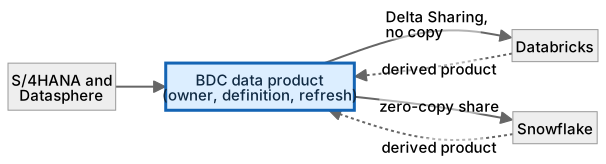
No hand-built extract. Queries run on the consumer side; the data stays in BDC.
A worked example, with numbers
A data scientist wants to train a late-payment model in the team’s existing Databricks. The FI-CA payment-behaviour data product is published in BDC with owner, definition and a daily refresh. Through BDC Connect for Databricks it appears as a shared catalog in their Unity Catalog; a notebook queries two years of history without a nightly extract, no copy inside Databricks that someone has to govern, until the scientist writes CREATE TABLE AS SELECT to cache a training set, which is a copy, now theirs to retain and delete. The trained risk score is published back to BDC as a new data product so S/4HANA apps and agents can consume it, with its own refresh stamp. The catalog shows who consumed the source product and when.
How the data flows

The check that actually matters
Zero-copy is not zero retention. A consumer can still write CREATE TABLE AS SELECT and keep a copy inside their platform, and that copy is theirs to govern. The share is also only as fresh as the data product’s last refresh, so it is not a live transaction feed: for today’s transaction, ask S/4HANA. This area moved fast: BDC Connect for Databricks was announced as generally available in October 2025, and SAP Snowflake and BDC Connect for Snowflake reached general availability in May 2026 (Snowflake documents that the integration is not available in its Virtual Private Snowflake and government regions). Check current documentation before designing around a specific capability.
Zero-copy is not zero retention. A consumer can still CREATE TABLE AS SELECT and keep a copy. Governance must cover what consumers build, not only the share.
Zero-copy sharing vs replication
| Question | Option A | Option B |
|---|---|---|
| Data movement | None; read in place | A copy is made and maintained |
| Freshness | As the product refreshes | As the pipeline runs |
| Semantics | Travel with the product | Re-mapped in the target |
| Governance | Central, until a consumer caches | Per copy |
What Zero-Copy Data Platforms does, and what it does not
It does
- SAP Business Data Cloud catalogs data products from S/4HANA and other SAP systems.
- BDC Connect shares them with Databricks and Snowflake, and derived products can be shared back; SAP Databricks and SAP Snowflake are the embedded options. Delta Sharing is the open protocol behind it.
- Semantics travel with the product, so ‘customer’ means the same thing on both sides.
It does not
- Make live transactions available. Data products refresh on a schedule.
- Govern downstream copies automatically.
- Replace Datasphere. Datasphere is a core component of BDC, post 14.
Three real situations
Payment behaviour analysis. A data scientist trains a late-payment model in Databricks on a governed FI-CA data product, without a nightly extract.
Enterprise analytics. Finance joins SAP data products with non-SAP data in Snowflake and publishes a derived product back to BDC.
AI context service. An agent’s context comes from a governed data product with a refresh timestamp, not from a spreadsheet someone exported.
In practice: what teams get wrong
SAP Business Data Cloud catalogs governed data products from S/4HANA and other SAP systems, each with an owner, a definition and a refresh cadence. Sharing is zero-copy over the open Delta Sharing protocol: the consumer queries the data where it lives, no pipeline, no duplication. Two paths exist for each partner, embedded (SAP Databricks inside BDC; SAP Snowflake provisioned from SAP for Me) and bring-your-own (BDC Connect for an existing Databricks or Snowflake account). Snowflake documents general availability of its SAP zero-copy connector on 4 May 2026. Sharing works in both directions, so a derived product can be published back to BDC. Semantics travel with the product, so ‘customer’ means the same on both sides.
From the field. I have seen ‘zero-copy’ sold as ‘zero governance’. The first derived table a consumer saved was an ungoverned copy of sensitive data, exactly what zero-copy was supposed to avoid.
Other gotchas worth a line:
- Agree who owns each data product and what ‘refreshed’ means.
- Cross-cloud and cross-region shares may add latency and cost; check with both vendors.
- A derived table in the consumer is a copy; decide its retention.
- BDC Connect for Snowflake was announced as generally available in May 2026; capabilities and regions change fast, so check the current SAP documentation.
Terms you will hear
| Term | Plain meaning |
|---|---|
| Business Data Cloud | SAP’s data platform that catalogs and shares data products. |
| Data product | A governed, owned, documented dataset. |
| Zero-copy | Reading data where it lives, without duplicating it. |
| Delta Sharing | The open protocol used for the share. |
| BDC Connect | Share to an existing Databricks or Snowflake account. |
| SAP Databricks | Databricks embedded inside BDC. |
| Bidirectional | Consume SAP data and publish results back. |
Quick self-check
- In one sentence, what is Zero-Copy Data Platforms’s job?
- Which decision does it not make, and who makes it instead?
- What is the one thing you would verify before calling it production-ready?
Show the answers
- Give Databricks, Snowflake and your own analysts governed SAP data without pipelines and copies.
- Make live transactions available. Data products refresh on a schedule.
- Agree who owns each data product and what ‘refreshed’ means.
Key takeaways
- Lend the data, do not photocopy it. Analytics platforms read SAP data products in place.
- Zero-copy is not zero retention.
- SAP Business Data Cloud catalogs data products from S/4HANA and other SAP systems.
- Make live transactions available. Data products refresh on a schedule.
- BDC Connect for Snowflake was announced as generally available in May 2026; capabilities and regions change fast, so check the current SAP documentation.
FAQs
Is this the same as replication?
No. The consumer reads the data where it is, through a sharing protocol, instead of receiving a copy.
Do I need Datasphere first?
Datasphere is a core component of Business Data Cloud, though SAP’s training material notes a formation is technically possible without it, at the cost of combining and enriching data products. Publishing Datasphere models as data products is one route.
Keep going in the series
Previous: Agent Platforms, A2A, MCP and APIs You have finished the series. Back to the series map, or try the labs.
Full map: SAP AI Components Explained — 17 posts from platform to agents.
Sources and research notes
Research checked on 21 October 2026. Product names, plans, models and regional availability change fast; the starting reference for this component is SAP Business Data Cloud and Databricks. Examples use a fictional utility company and fictional cases (amounts, IDs, names); no customer landscape is described.
Recap
Zero-Copy Data Platforms: give Databricks, Snowflake and your own analysts governed SAP data without pipelines and copies. The result is governed sap data in your analytics platform, without copies. The one thing to remember: zero-copy is not zero retention.
Found this useful? That completes the series: the series map lists all 17 posts, and the labs put them to work. Share it with the SAP colleague who keeps asking what all these components actually do.
Frequently asked questions
Is this the same as replication?
No. The consumer reads the data where it is, through a sharing protocol, instead of receiving a copy.
Do I need Datasphere first?
Datasphere is a core component of Business Data Cloud, though SAP's training material notes a formation is technically possible without it, at the cost of combining and enriching data products. Publishing Datasphere models as data products is one route.
Further reading
- SAP Business Data Cloud and Databricks — SAP
- SAP Snowflake and SAP BDC Connect for Snowflake: general availability — SAP Community
- About Snowflake and SAP Zero-Copy Integration — Snowflake
- May 4, 2026: SAP BDC Zerocopy Connector (General availability) — Snowflake
- Announcing general availability of SAP Business Data Cloud Connect for Databricks — Databricks
Continue your trail
You now have the SAP AI Components context.
Save this guide, continue to the next concept or return to the Knowledge Library with your context intact.
SAP AI Components
17 resources in this area.

Practical SAP notes, structured for review, reuse and long-term maintenance.
Working on an FI-CA or IS-U implementation? I take on a limited number of advisory and architecture engagements.
Get in touch →